how much deposit to buy a house australia
How Much Deposit Do You Need to Buy a House in Australia in 2026?

The deposit is the single biggest barrier between most Australians and home ownership. Not the mortgage repayments. Not the interest rate. The deposit. Scraping together $80,000, $100,000, or more while paying rent feels, for many buyers, like running on a treadmill that keeps speeding up.
But here is the thing: the rules around deposits have changed significantly over the past few years, and most buyers are still working from outdated assumptions. The blanket belief that you need 20% saved before you can even speak to a lender is simply not accurate in 2026. There are genuine low-deposit pathways, government guarantees, and lender options that can get you into a property with as little as 5% saved, if you understand how the system works.
This guide breaks down exactly what you need, what it costs, and what trade-offs you are making at each deposit level. Whether you are saving your first deposit or trying to buy again after a break, the numbers here are real and the advice is practical.
Key Takeaways
- The standard 20% deposit benchmark exists to avoid Lenders Mortgage Insurance (LMI), not because lenders require it.
- You can buy with as little as 5% deposit through the federal First Home Guarantee scheme, which removes LMI entirely for eligible buyers.
- LMI can cost between $8,000 and $35,000 or more depending on the property price and loan-to-value ratio.
- Lenders assess "genuine savings" carefully. Money gifted by family or received as a windfall rarely counts on its own.
- Upfront costs beyond the deposit, including stamp duty, conveyancing, and building inspections, typically add 3-5% to your purchase price.
- A larger deposit directly improves your interest rate and borrowing power, sometimes by more than most buyers realise.
Summary Table: Deposit Options at a Glance
| Deposit Level | LMI Payable | Government Scheme Available | Suitable For |
|---|---|---|---|
| 5% | No (if using First Home Guarantee) | Yes, First Home Guarantee | First home buyers, income caps apply |
| 5-8% | Yes, high LMI cost | Partial (check eligibility) | Buyers who miss scheme allocation |
| 10% | Yes, moderate LMI cost | No (above threshold for some schemes) | Repeat or first home buyers |
| 15% | Yes, lower LMI cost | No | Buyers close to avoiding LMI |
| 20%+ | No | No | Any buyer, best rates available |
The 20% Deposit Benchmark: Why It Exists and What It Actually Means
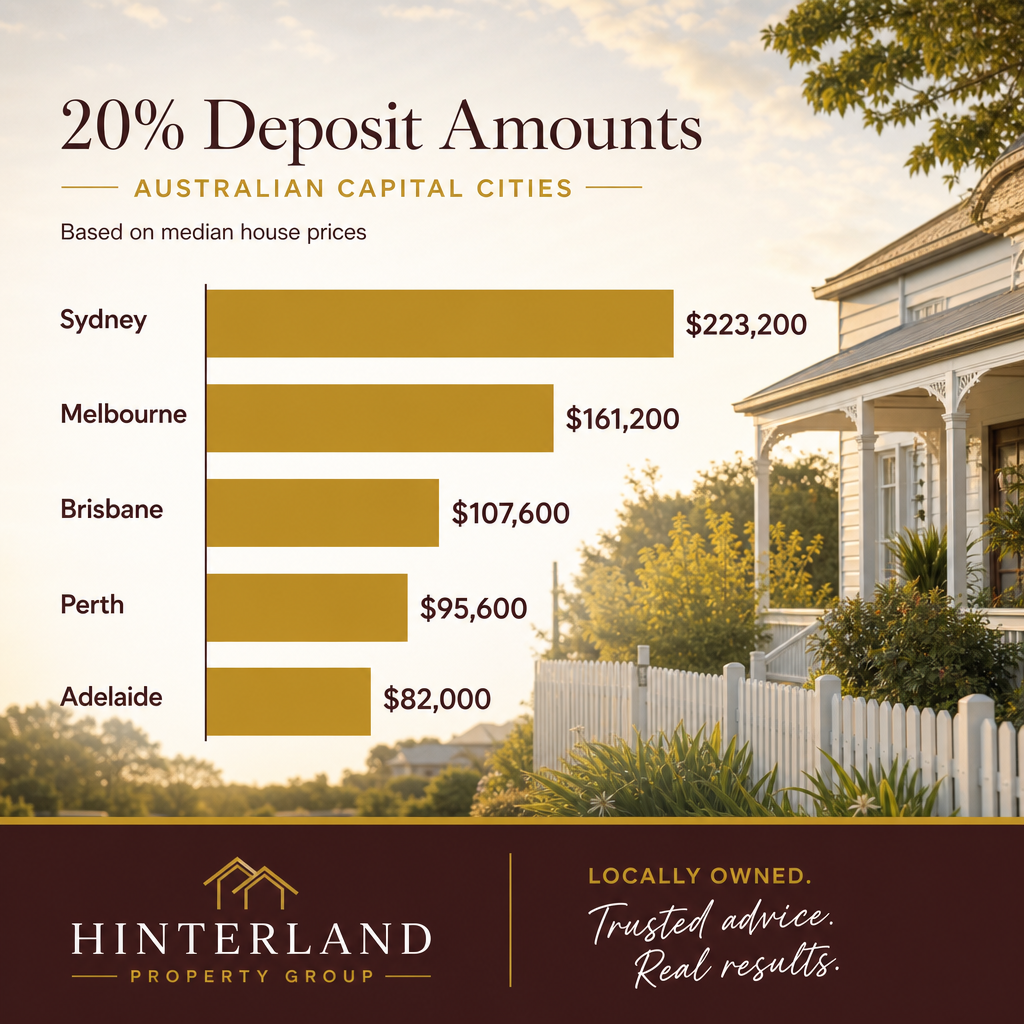
Lenders set 20% as the threshold where they consider a loan low-risk. Borrow less than 80% of the property's value and you avoid Lenders Mortgage Insurance. Borrow more and the lender requires you to pay LMI, which protects the lender (not you) if you default.
The logic is straightforward. A borrower with 20% equity has demonstrated savings discipline, has a meaningful financial stake in the property, and gives the lender a buffer if the market softens and they need to sell. APRA (the Australian Prudential Regulation Authority) has historically used loan-to-value ratio (LVR) thresholds as a key lever in managing systemic lending risk, which is why the 80% LVR figure is so embedded in Australian mortgage policy.
For most capital cities in 2026, reaching 20% is a significant undertaking. Using ABS median dwelling price data as a baseline:
- Sydney: Median house price approximately $1.47 million. A 20% deposit is around $294,000.
- Melbourne: Median around $940,000. A 20% deposit is approximately $188,000.
- Brisbane: Median around $890,000. A 20% deposit is approximately $178,000.
- Perth: Median around $760,000. A 20% deposit is approximately $152,000.
- Adelaide: Median around $820,000. A 20% deposit is approximately $164,000.
For most working Australians, saving $180,000-$294,000 while renting takes many years, sometimes over a decade in Sydney or Melbourne. That is the real reason low-deposit pathways exist and why understanding them is not a shortcut, but a necessity.
What Counts as a Genuine Deposit?
Lenders do not simply take your word for it that you have savings. They scrutinise where your deposit came from, and the concept of "genuine savings" is one of the most misunderstood parts of the home loan process.
Genuine savings, in most lenders' definitions, are funds you have accumulated yourself over at least three months. This typically includes:
- Regular salary deposits into a savings account
- Term deposit proceeds
- Shares or managed funds held for 90 or more days
- Equity in an existing property
What often does not count as genuine savings (or only partially counts):
- Lump-sum cash gifts from family
- First Home Super Saver Scheme (FHSSS) withdrawals (treatment varies by lender)
- Tax refunds received as a one-off payment
- Inheritance received recently
This matters because a parent handing over $50,000 will not automatically satisfy a lender's genuine savings requirement. Some lenders will accept gifted funds if they have been sitting in your account for at least three months and you have other demonstrated savings behaviour, but every lender has its own policy. This is where working with a mortgage broker or finance specialist who knows the lender matrix becomes genuinely valuable.
Lenders Mortgage Insurance: The Real Cost of a Small Deposit
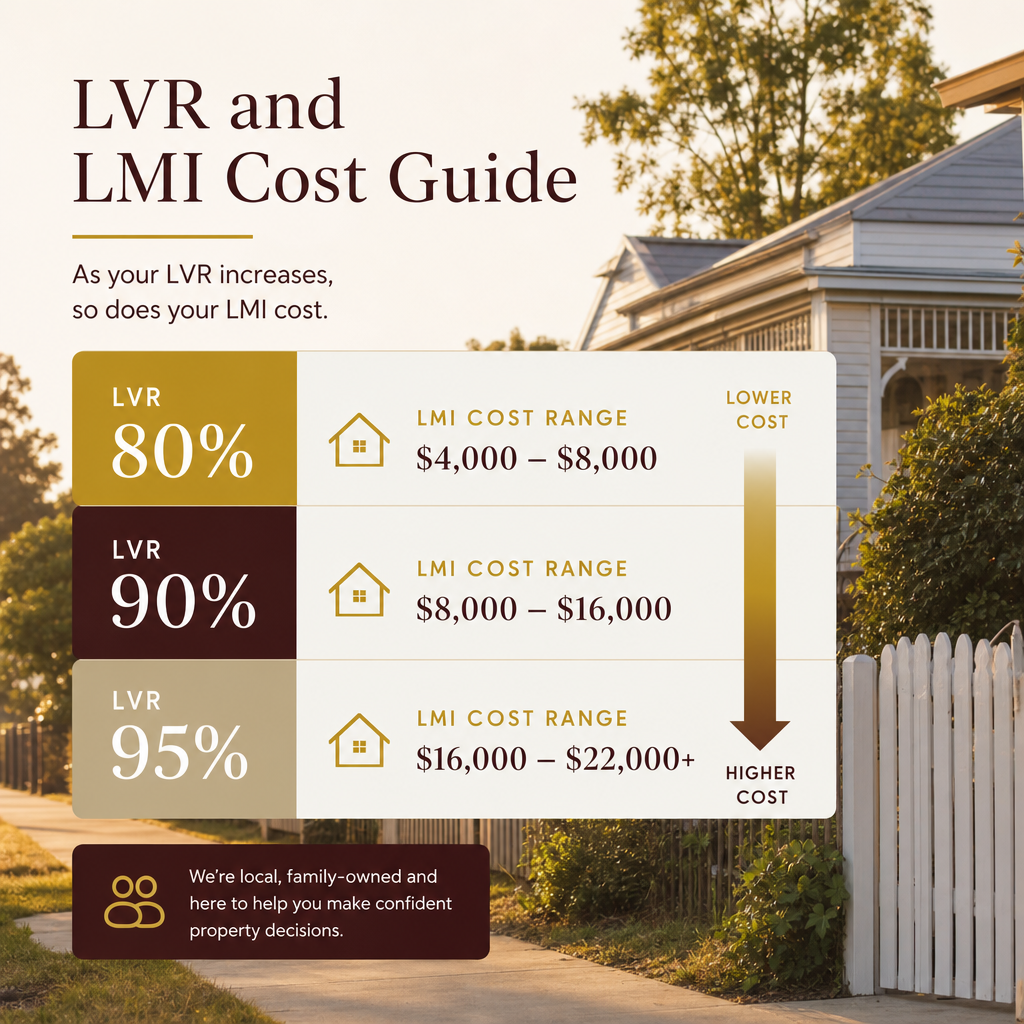
LMI is not a small fee. It is a one-off premium, typically added to your loan, that can represent tens of thousands of dollars. Most buyers are surprised by the actual figures.
Here is a realistic example. A property purchased in Brisbane for $750,000 with a 10% deposit ($75,000) means a loan of $675,000, an LVR of 90%. LMI on a loan of this size sits roughly in the range of $14,000 to $18,000 depending on the insurer and lender. That amount is usually capitalised onto the loan, so you are also paying interest on it for the life of the mortgage.
At a 95% LVR (5% deposit) on the same $750,000 property, LMI can climb to $22,000 to $28,000 or higher.
Two major LMI providers in Australia are Helia (formerly Genworth) and QBE LMI. Their premium scales vary, but both increase sharply as the LVR climbs above 90%.
Is LMI Always the Wrong Move?
Not necessarily. LMI gets a bad reputation, but it is worth running the numbers before dismissing it.
If you are in a market where property values are rising at 6-8% annually, waiting two extra years to save a full 20% deposit could cost you more in missed capital growth than you would pay in LMI. This is not a guarantee, property markets move in cycles, but it is a real trade-off that deserves analysis rather than dogma.
The question to ask is not "can I avoid LMI?" but "what does it cost me to pay LMI versus what does it cost me to wait?" A good finance specialist can model this comparison for your specific situation. You can explore your finance options with the team at George & Sons here.
The 5% Deposit Pathway: First Home Guarantee Explained
The federal government's First Home Guarantee (formerly the First Home Loan Deposit Scheme), administered by Housing Australia (formerly NHFIC), allows eligible first home buyers to purchase with a 5% deposit and no LMI. The government guarantees up to 15% of the loan, removing the need for LMI without the buyer needing to come up with the full 20%.
For 2026, the key eligibility criteria are:
- Australian citizen or permanent resident
- First home buyer (have not owned property in Australia previously)
- Income caps: $125,000 per annum for singles, $200,000 combined for couples
- Property must be below regional price caps (these vary by city and region)
- Property must be owner-occupied, not for investment
Price caps are updated periodically, and for the major capitals in 2026 they sit at approximately:
- Sydney and NSW regional centres: $900,000
- Melbourne and regional Victoria: $800,000
- Brisbane and regional Queensland: $700,000
- Perth: $600,000
- Adelaide: $600,000
The scheme is allocated on a per-financial-year basis, with 35,000 places available in 2026. Places are not unlimited and do fill. Applying through a participating lender early in the financial year improves your chances.
The Regional First Home Buyer Guarantee
A separate but related scheme, the Regional First Home Buyer Guarantee, offers similar terms but is specifically for buyers purchasing in regional Australia. If you are considering a purchase outside a major capital city, this scheme may apply and is worth checking with an eligible lender.
Beyond the Deposit: Upfront Costs You Cannot Ignore
One of the most common mistakes first home buyers make is calculating their deposit correctly but underestimating the additional upfront costs. In most Australian states, these will add 3-5% to your total cash requirement on top of the deposit itself.
Stamp Duty
Stamp duty is the largest variable cost. It is a state government tax calculated on the purchase price of the property. Each state has different rates and concessions.
For a $750,000 purchase in Queensland, stamp duty is approximately $27,090 for an owner-occupier who does not qualify for first home buyer concessions. Queensland's first home buyer concession reduces or eliminates stamp duty on homes valued under a certain threshold. As of 2026, the threshold for full concession sits at $700,000 for first home buyers, with a partial concession up to $800,000. If you are buying in Queensland and are a first home buyer, this alone can save you upwards of $15,000.
Victoria, New South Wales, and South Australia each have their own rate schedules and concession regimes. Do not assume the rate you read about last year still applies. Confirm with your conveyancer or solicitor before you make an offer.
Conveyancing and Legal Fees
A licensed conveyancer or property solicitor handles the legal transfer of the property. In Queensland, fees typically range from $1,200 to $2,500 for a standard residential purchase. Costs vary based on complexity, property type, and firm.
Building and Pest Inspections
A building and pest inspection before purchase is not optional if you are buying an established property. A qualified inspector will assess structural integrity, moisture, termite activity, and other risks. Costs range from $400 to $800 for a combined report, depending on property size and location. Skipping this to save a few hundred dollars is one of the most expensive mistakes a buyer can make.
Loan Application and Establishment Fees
Some lenders charge loan application fees, valuation fees, and settlement fees. These have become less common with competition in the mortgage market, but check your loan product's fee schedule carefully. Budget $500 to $1,500 to cover these across the purchase process.
Moving Costs and Immediate Repairs
Once you hold the keys, removalists, connection fees, and any immediate maintenance or repairs add to your cash outlay. These are personal costs but worth including in your total budget.
How Deposit Size Affects Your Interest Rate and Borrowing Power
Beyond LMI, the size of your deposit directly influences the interest rate you are offered and your overall borrowing power. Both of these effects are more significant than most buyers appreciate.
LVR Pricing Tiers
Most lenders price their loans in LVR tiers. A borrower at 60% LVR (40% deposit) will typically receive a lower interest rate than a borrower at 90% LVR (10% deposit). The difference can be 0.2% to 0.6% per annum depending on the lender and product.
On a $600,000 loan over 30 years, a 0.4% rate difference costs approximately $48,000 to $55,000 extra in total interest. That is a meaningful number. Reaching a lower LVR tier, whether by saving more or through capital growth in a bridging situation, has long-term financial consequences.
Borrowing Power
Lenders calculate your borrowing power (the maximum loan amount they will offer you) based on your income, liabilities, living expenses, and the loan's serviceability rate. A larger deposit does not directly increase your income-based borrowing power, but it reduces the loan amount you need, which in turn reduces your repayment obligations and can sometimes open access to lenders who have tighter LVR restrictions.
For buyers sitting on the edge of a lender's qualifying criteria, a slightly larger deposit can be the difference between conditional approval and outright decline.
Case Study 1: First Home Buyer Using the First Home Guarantee
A couple came to us in mid-2025 with $52,000 saved between them. Both were working full-time, combined income just under $185,000 a year, and they had been renting in the southern Brisbane suburbs for four years. Their goal was a house in the $650,000-$700,000 range.
At first, they believed they needed at least $140,000 (20% of a $700,000 purchase) before they could move. That felt years away. When we walked them through the First Home Guarantee, the picture changed completely.
With $52,000, they had just over 7% of a $700,000 purchase covered. After factoring in Queensland stamp duty concessions as first home buyers (approximately $7,175 payable on a $680,000 purchase at that time), legal fees, and inspection costs, they needed to keep approximately $12,000 aside for costs. That left them with $40,000 toward a deposit on a property up to $700,000, which at 5.7% LVR technically did not meet the 5% requirement on its own.
We worked with their broker to identify that they had one further month of savings that would bring the deposit to 5.3% of a $690,000 purchase, with the remainder covered by the scheme guarantee. They secured a place in the First Home Guarantee allocation and settled on a three-bedroom house in Beenleigh in early 2026 with no LMI. Their first monthly repayment was less than what they had been paying in rent.
Case Study 2: Upgrader Weighing LMI Against Waiting
Another client, a single buyer in her late thirties, owned a unit in Logan that had grown in value. She wanted to upgrade to a freestanding home but her equity, after legal costs of selling, would amount to approximately 13% of her target purchase price of $780,000.
Her options were: wait another 12-18 months to save the additional 7% needed to avoid LMI, or proceed at 87% LVR and pay LMI of approximately $12,800.
We pulled together comparable sales data for the area she was targeting. Properties in that suburb had risen approximately 9% year-on-year for the prior 24 months. Waiting 18 months to save $54,600 (7% of $780,000) risked the median purchase price moving to $850,000 or higher, requiring an even larger deposit to hit 20%.
She chose to proceed. Her LMI was $12,900. The suburb's median moved up approximately 7% in the subsequent 12 months. She was ahead. Not every outcome works out this way, and we were clear about the risk, but the numbers supported moving.
What I Have Learned from Years of Helping Buyers Navigate This
I have been doing this long enough to know that the deposit question is rarely just about the number. When I first started working with property buyers and developers in Brisbane's south, I quickly learned that what people think they need and what they actually need are often two different things.
I remember working with a developer who was not sure what I could actually do for him. He told me straight: "Give it a go, but I am not sure you can do much." That was back in January 2021, and we have now sold twelve apartments in his Beenleigh complex with more in the pipeline. The reason it worked was not because I had a magic formula. It was because I took the time to understand the complex, the body corporate, and what mattered to each buyer who walked through the door. The same principle applies to deposit conversations. Every buyer's situation is different. The investor's deposit strategy looks nothing like the first home buyer's, and the upgrader's is different again.
If you are uncertain about where you sit, the best first step is a conversation with someone who will look at your full picture rather than hand you a brochure. Talk to us at George & Sons and we can point you toward the right finance and property guidance for your situation.
Using the First Home Super Saver Scheme to Build Your Deposit Faster
The First Home Super Saver Scheme (FHSSS) allows eligible first home buyers to make voluntary concessional contributions into their superannuation fund and then withdraw those contributions (plus associated earnings) for a property deposit. As of 2026, the maximum releasable amount is $50,000 per person ($100,000 for a couple).
The tax advantage is real. Voluntary concessional contributions are taxed at 15% inside super, compared to your marginal income tax rate (which may be 32.5% or 37% for most working Australians). The difference in net savings can be meaningful over two to three years.
However, the FHSSS has administrative complexity and the released funds take time to process through the ATO. It is not a scheme for buyers who need to act within weeks, but it is a legitimate accelerant for buyers who are 12-36 months away from purchase.
Choosing Between a Smaller Deposit Now and Waiting to Save More
This is the central question most buyers face, and there is no universal answer. The right decision depends on:
- Your local market trajectory. A buyer in a suburb growing at 10% per year loses more by waiting than a buyer in a flat market.
- Your LMI cost relative to your income. A $15,000 LMI on a $70,000 income is a bigger impost than the same amount on a $120,000 income.
- Your stage of life. School zones, family planning, and employment stability all factor into whether flexibility or certainty matters more.
- The interest rate environment. Higher interest rates increase the carrying cost of a larger loan, which changes the LMI trade-off calculation.
Our property listings page can help you understand what is currently available at different price points in Brisbane's south, and our team can help you connect the dots between what is on the market and what your deposit can realistically achieve.
A Note on Guarantor Loans
Some lenders offer guarantor loans, where a family member (usually a parent) uses the equity in their own property to guarantee part of your loan. This can allow you to borrow up to 100% of the purchase price in some cases, avoiding both the deposit saving period and LMI.
Guarantor arrangements carry significant legal and financial implications for the guarantor. If you default, the guarantor's property can be at risk. This is a genuine option for some buyers, but it requires honest family conversations, independent legal advice for the guarantor, and a clear exit strategy (usually refinancing once the property has grown in equity).
Quick Stats: The Deposit Landscape in 2026
- Average time to save a 20% deposit in Sydney: approximately 10-12 years for a median income household (ABS income and housing data).
- First Home Guarantee places available nationally in 2026: 35,000.
- Approximate LMI cost at 90% LVR on a $700,000 loan: $13,000-$18,000.
- FHSSS maximum withdrawal per person: $50,000.
- Most common first home buyer deposit size in Australia: 10-15% (Housing Australia data).
Ready to Work Out Your Deposit Strategy?
Knowing the rules is the first step. Working out which ones apply to your income, your timeline, and your target suburb is where the real planning starts. Our team at George & Sons works with buyers across Brisbane's south and beyond to match financial reality with the right property at the right time.
Book a free consultation with us today and let us help you map a clear path from where you are now to where you want to be.
You can also browse our current listings to get a feel for what is on the market right now, or learn more about our real estate services.
References
-
Australian Bureau of Statistics (ABS), Housing Finance and Dwelling Price data, 2026 - ABS publishes quarterly data on median dwelling prices across Australian capital cities and regions, as well as data on housing finance commitments and average loan sizes. Used here for median price estimates and deposit benchmarking.
-
Australian Prudential Regulation Authority (APRA), Residential Mortgage Lending Statistics - APRA publishes quarterly data on loan-to-value ratios, high-LVR lending volumes, and bank portfolio compositions. This data underpins the 80% LVR industry benchmark and systemic risk framework for Australian mortgage lenders.
-
Housing Australia (formerly NHFIC), First Home Guarantee Scheme Guidelines and Annual Report 2025-26 - Housing Australia administers the First Home Guarantee, Regional First Home Buyer Guarantee, and related schemes. Eligibility criteria, price caps, and annual place allocations are sourced from their official scheme documentation.
-
Australian Taxation Office (ATO), First Home Super Saver Scheme Guidance - The ATO administers the FHSSS and publishes detailed guidance on contribution limits, withdrawal rules, and tax treatment. The $50,000 maximum release per person figure is drawn from current ATO scheme documentation for 2025-26.
-
Helia (formerly Genworth Australia), LMI Premium Estimator and Product Disclosure Statement - Helia is one of Australia's two major LMI providers and publishes indicative premium ranges by LVR band and loan amount. Used here for LMI cost examples at various LVR tiers.
-
Real Estate Institute of Queensland (REIQ), Median Price Reports 2025-26 - REIQ publishes quarterly suburb and regional median sale price data for Queensland residential property. Used here to inform Brisbane and southeast Queensland price examples and suburb-level market commentary.
Get tailored guidance
Send us your question and we will reply within one business day.
Send us the article topic, suburb, or property goal you want help with and we will reply within one business day.
Send my questionFAQ
How much deposit do I need to buy a house in Australia in 2026?
The minimum deposit most lenders accept is 5% of the property's purchase price. However, with a deposit below 20%, you will generally pay Lenders Mortgage Insurance (LMI) unless you qualify for the federal First Home Guarantee scheme, which allows eligible first home buyers to purchase with a 5% deposit and no LMI. A 20% deposit removes LMI entirely and typically secures you a better interest rate.
What is Lenders Mortgage Insurance and do I have to pay it?
LMI is an insurance premium charged by the lender when you borrow more than 80% of a property's value. It protects the lender, not you, if you default on the loan. LMI can range from around $8,000 to over $30,000 depending on the loan size and LVR. You can avoid it by saving a 20% deposit, qualifying for the First Home Guarantee, or using a guarantor arrangement.
What is the First Home Guarantee and who is eligible?
The First Home Guarantee is a federal government scheme administered by Housing Australia that allows eligible first home buyers to purchase with a 5% deposit and no LMI, because the government guarantees up to 15% of the loan. To be eligible in 2026 you must be an Australian citizen or permanent resident, a first home buyer, earn under $125,000 as an individual or $200,000 as a couple, and purchase a property below the relevant price cap for your region.
What counts as genuine savings for a home loan?
Genuine savings are funds you have saved yourself over at least three months, typically demonstrated through bank statements showing regular deposits. They include savings accounts, term deposits, shares held for 90-plus days, and equity in existing property. Lump-sum gifts from family, recent tax refunds, or inherited funds may not satisfy a lender's genuine savings requirement on their own, though some lenders accept gifted funds held in your account for three or more months alongside demonstrated savings behaviour.
What other upfront costs should I budget for beyond the deposit?
Beyond your deposit, budget for stamp duty (which varies by state and whether you qualify for first home buyer concessions), conveyancing and legal fees (typically $1,200 to $2,500), building and pest inspection fees ($400 to $800), and loan establishment fees where applicable. In total, additional upfront costs usually add 3-5% to your purchase price. First home buyers in Queensland may pay reduced or no stamp duty depending on the purchase price.
Does a bigger deposit improve my interest rate?
Yes. Most lenders price loans in LVR tiers, meaning borrowers with a lower LVR (larger deposit relative to the property value) are offered lower interest rates. The difference between an 80% LVR rate and a 90% LVR rate can be 0.2% to 0.6% per annum, which over a 30-year loan amounts to tens of thousands of dollars in additional interest costs.
Can I use the First Home Super Saver Scheme to boost my deposit?
Yes. The FHSSS allows you to make voluntary superannuation contributions and then withdraw up to $50,000 per person (or $100,000 for a couple) for a first home deposit. Contributions made inside super are taxed at 15%, which is lower than most people's marginal income tax rate, making this an effective savings accelerant for buyers who are 12-36 months away from purchasing.
What is a guarantor loan and is it a good option?
A guarantor loan allows a family member, usually a parent, to use the equity in their own property as security for part of your loan. This can enable you to borrow with little or no deposit and avoid LMI. However, the guarantor's property is at risk if you default, so the arrangement requires careful planning, independent legal advice for the guarantor, and a clear strategy for releasing the guarantee once your property builds sufficient equity.
Margy George
Property and finance guidance from the George & Sons team.
Keep reading
stamp duty when buying property australia
Stamp Duty When Buying Property in Australia: How Much You'll Pay in 2026
28 min read
how to buy a house at auction
How to Buy a House at Auction in Australia: A Buyer's Complete Guide for 2026
22 min read
property management fees Australia
Property Management Fees in Australia: A Comprehensive Guide for Landlords
19 min read
Ready for clarity?
Get a calm, practical plan for your next property move.
Buying, selling, finance, or renting - tell us what you are working on and we will come back with the most useful next step.
Tell us what you need help with.
Send a quick enquiry and the team will come back with a clear next step.
Request a callback