capital gains tax selling property Australia
Capital Gains Tax When Selling Property in Australia: What Every Seller Needs to Know
Most Australian property sellers walk into a sale either convinced they owe nothing or blindsided by a tax bill they never saw coming. Both mistakes cost real money. Overestimating your CGT exposure can push you to delay a sale unnecessarily, costing you opportunity. Underestimating it leaves you scrambling come tax time, sometimes with penalties attached. The Australian Taxation Office (ATO) collected billions in capital gains tax from property transactions in the 2024-25 financial year, and a significant share of that came from sellers who simply did not understand the rules.
Capital gains tax on property in Australia is not a separate tax. It is part of your income tax assessment, and that distinction matters more than most people realise. Your capital gain gets added to your taxable income for the year, which means a large gain can push you into a higher marginal tax bracket and affect everything from your Medicare levy surcharge threshold to your HECS repayments. The good news is that the rules also contain generous concessions, including a full main residence exemption, a 50 percent discount for assets held longer than 12 months, and the six-year absence rule that many sellers overlook entirely.
This guide covers everything you need to know before you sell. Whether you are selling your family home, an investment property, or an inherited asset, understanding CGT before you sign a contract gives you options. Once contracts exchange, most of those options are gone.
Key Takeaways
- Your primary residence is generally fully exempt from CGT, but there are specific conditions that must be met and common traps that void that exemption.
- If you have owned an investment property for more than 12 months, you are eligible for a 50 percent CGT discount as an individual, which halves the taxable capital gain.
- Calculating your capital gain correctly requires understanding your cost base, which includes more than just the purchase price.
- The six-year absence rule allows you to treat a former home as your main residence for up to six years after you move out, potentially eliminating CGT entirely.
- Inherited property has its own CGT rules, and the tax treatment depends heavily on when the deceased originally acquired the asset.
- Timing your sale to fall in the right financial year, or offsetting gains with capital losses, can meaningfully reduce your CGT liability.
Summary Table: CGT Treatment by Property Scenario
| Scenario | CGT Applies? | Discount Available? | Key Conditions |
|---|---|---|---|
| Primary residence (lived in entire ownership period) | No | N/A | Must be your main residence throughout; land under 2 hectares |
| Investment property held less than 12 months | Yes | No | Full gain added to taxable income |
| Investment property held more than 12 months | Yes | 50% discount (individuals) | Must be an Australian resident at time of sale |
| Primary residence used partly for income (e.g. rental) | Partial | Yes, on eligible portion held 12+ months | Apportioned based on floor area and time |
| Six-year absence rule (former home rented out) | Potentially no | N/A | No other property nominated as main residence during absence |
| Inherited property (deceased acquired pre-20 Sep 1985) | No | N/A | Pre-CGT asset; full exemption applies |
| Inherited property (deceased acquired post-20 Sep 1985) | Yes | Potentially | Cost base resets to market value at date of death |
| Vacant land (not used as main residence) | Yes | Yes, if held 12+ months | No main residence exemption available |
What Is CGT and When Does It Apply to Property
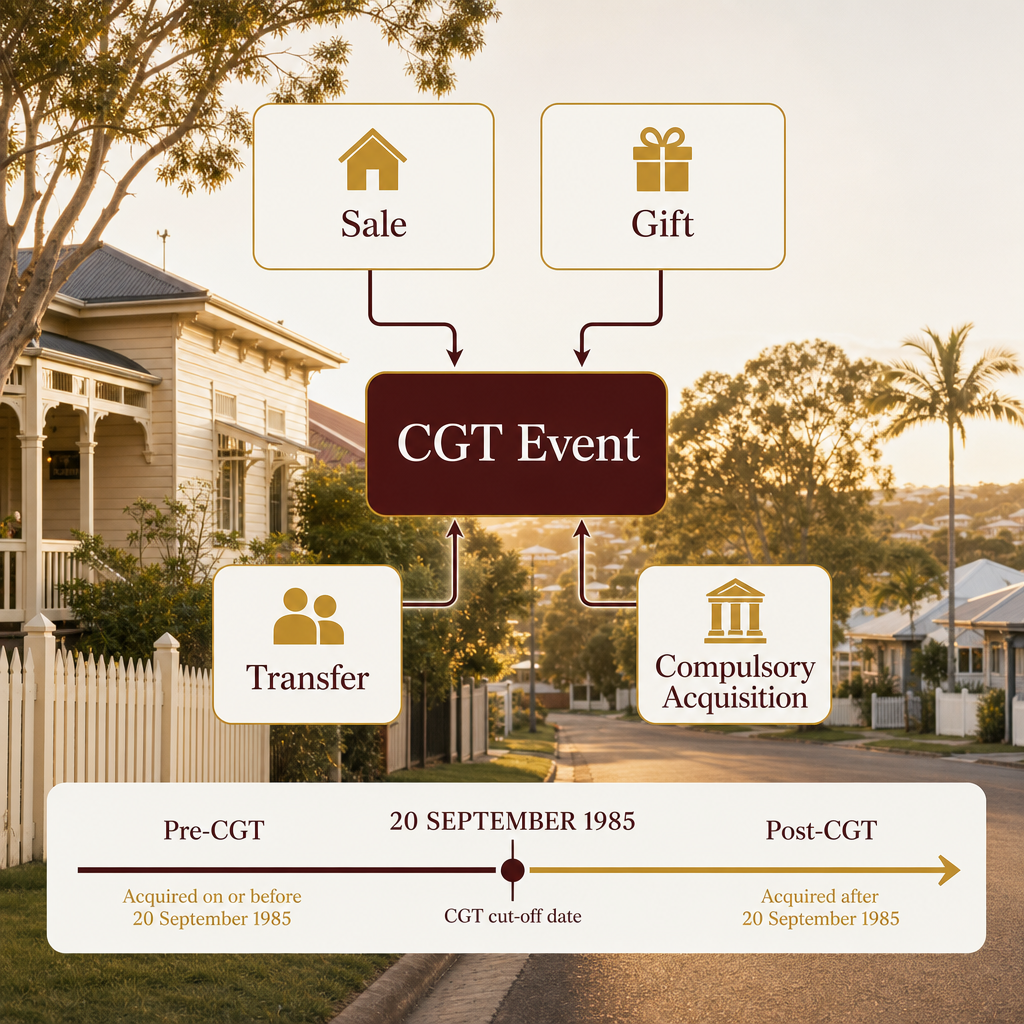
Capital gains tax applies when you dispose of a capital asset for more than you paid for it. In the context of property, a "disposal" includes selling, gifting, transferring, or in some cases demolishing a property. The gain is the difference between what you received for the property (the capital proceeds) and what it cost you to acquire and hold it (the cost base).
CGT was introduced in Australia on 20 September 1985. Any property acquired before that date is considered a pre-CGT asset, and no capital gains tax applies when it is sold. For the vast majority of sellers today, this is not relevant, but it becomes important when dealing with deceased estates where the original owner purchased decades ago.
It is worth repeating: CGT is not a separate tax with its own rate. Your net capital gain is included in your assessable income for the financial year in which the contract is exchanged, not the settlement date. This is a critical point. If you exchange contracts in June and settle in August, the CGT liability falls in the June financial year. That timing has real implications for tax planning.
For property specifically, the ATO considers the following events as CGT events:
- Selling a property you own outright
- Selling your share of a jointly owned property
- Transferring property to a family trust or company
- Gifting a property to another person (the market value at the time of the gift is used as the capital proceeds)
- Compulsory acquisition by a government authority
Understanding when CGT is triggered and in which financial year allows you to plan around it. That planning window closes the moment contracts are exchanged.
Primary Residence Exemption Explained
The main residence exemption is the most valuable CGT concession available to Australian property owners. If a property has been your main residence for the entire period you owned it, you pay no CGT when you sell it. Full stop.
However, there are conditions. The property must have been your home throughout the ownership period, not just at the time of sale. The land area must be two hectares or less (larger rural properties are treated differently). And critically, you cannot have used the property to produce income during that time without affecting your exemption.
The "income-producing use" trap catches more sellers than you might expect. If you rented out a room on Airbnb, claimed a home office deduction, or rented the property while you were overseas, you may have partially voided the main residence exemption. The ATO apportions the exemption based on the percentage of the property used for income-producing purposes and the length of time it was used that way.
For example, if you owned a four-bedroom home and consistently rented out one room (25 percent of the floor area) for three of the ten years you owned it, you would need to calculate the capital gain on that 25 percent for that three-year period. The remaining portion of the gain would still be exempt. And because you held the property for more than 12 months, the 50 percent CGT discount would apply to the taxable portion.
The exemption also does not apply to properties held through companies or most trusts. It is available to individuals and, in certain circumstances, to trustees of a special disability trust.
Calculating Your Capital Gain Step by Step
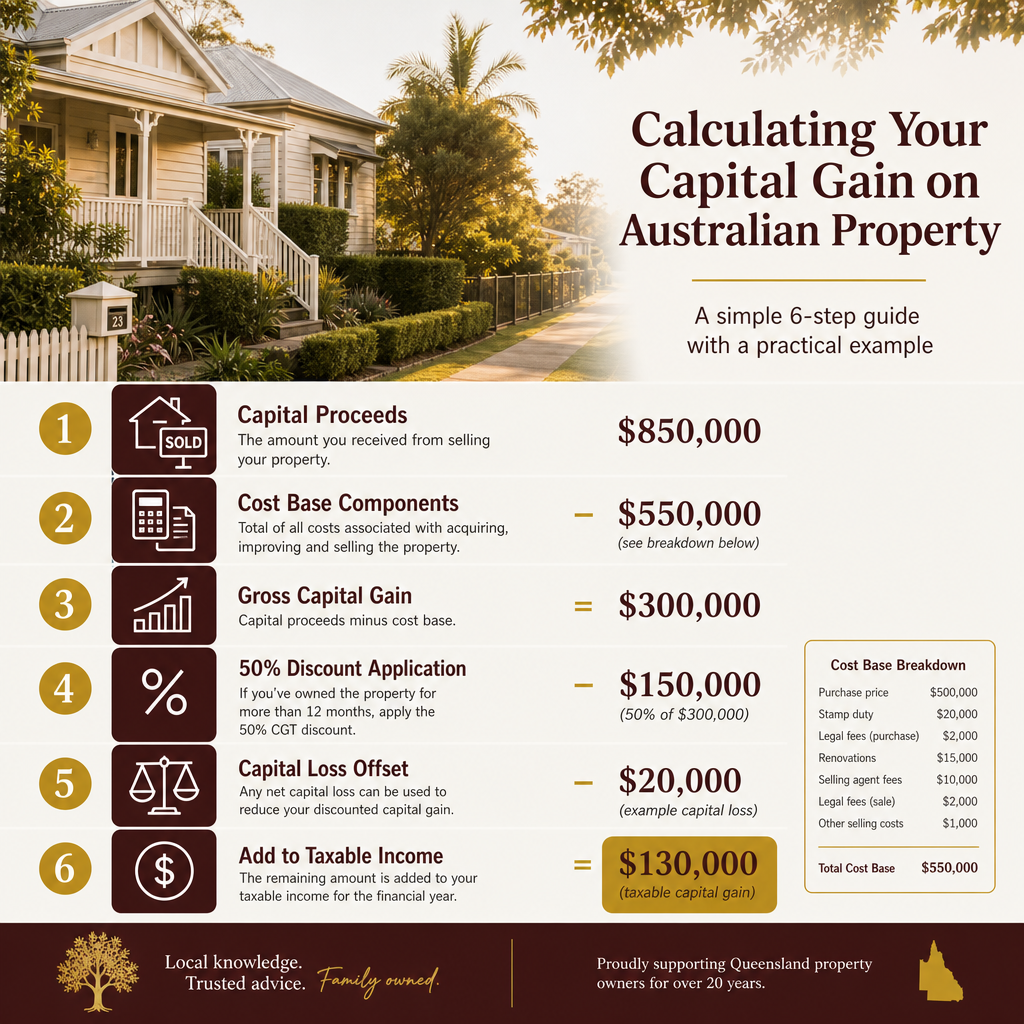
Calculating your capital gain sounds straightforward: subtract what you paid from what you received. In practice, it is more nuanced, and getting it wrong in either direction costs you money.
Here is the step-by-step process:
Step 1: Determine your capital proceeds
This is the amount you received from the sale, or the market value of the property if you transferred it without full commercial consideration. If you sold for $850,000, your capital proceeds are $850,000.
Step 2: Calculate your cost base
Your cost base is not just the purchase price. The ATO allows you to include the following:
- The original purchase price
- Stamp duty paid on purchase
- Legal and conveyancing fees on purchase and sale
- Real estate agent commissions on sale
- Capital improvements made to the property (renovations, extensions, structural work)
- Costs to establish or defend your title to the property
- Costs of borrowing (to a limited extent, particularly if not already claimed as a tax deduction)
What you cannot include in your cost base are expenses you have already claimed as income tax deductions. If you claimed depreciation on a rental property, that depreciation reduces your cost base dollar for dollar. Many sellers forget this. They add up their purchase price, add their renovations, and ignore the depreciation they claimed for ten years. The ATO absolutely does not ignore it.
Step 3: Calculate the gross capital gain
Subtract the cost base from the capital proceeds. If your proceeds are $850,000 and your cost base is $600,000, your gross capital gain is $250,000.
Step 4: Apply the 50 percent discount (if eligible)
If you are an individual or a trust, and you have owned the property for more than 12 months, you can reduce that gain by 50 percent. Your taxable capital gain becomes $125,000.
Step 5: Offset any capital losses
If you have capital losses from other assets in the current year, or carried forward from prior years, you apply those now. Capital losses can only be offset against capital gains, not against other income.
Step 6: Add the net capital gain to your taxable income
The resulting figure is added to your other assessable income for that financial year and taxed at your marginal rate.
The 50 Percent CGT Discount
The 50 percent CGT discount is available to Australian resident individuals and some trusts when they dispose of an asset that has been held for at least 12 months. For property investors, this is one of the most powerful tax concessions available.
To be clear about how it works: the discount does not reduce your tax rate. It reduces the amount of the gain that is included in your taxable income. If your gross capital gain is $300,000 and you are eligible for the discount, only $150,000 is added to your taxable income. You then pay tax on that $150,000 at your marginal rate.
For a high-income earner on the top marginal rate of 47 percent (including the Medicare levy), that still means paying around $70,500 in tax on a $300,000 gain. But without the discount, you would be paying $141,000. The discount is genuinely significant.
Companies are not eligible for the 50 percent CGT discount. This is one reason why holding investment properties in a company structure is generally not recommended for individual investors seeking to benefit from this concession. A company pays a flat rate of 30 percent (or 25 percent for base rate entities) on the full capital gain.
Self-managed super funds (SMSFs) are eligible for a one-third discount on assets held for more than 12 months, which effectively means they pay tax on two-thirds of the gain. In the accumulation phase, SMSFs pay 15 percent tax, so the effective rate on a discounted gain is 10 percent. That is a compelling reason why many Australians hold investment property inside an SMSF.
Six-Year Absence Rule
The six-year absence rule is, in my experience, the most underutilised CGT concession in Australian property. I have seen sellers pay tens of thousands of dollars in tax they did not need to pay simply because they were not aware this rule existed.
Here is how it works. If you move out of your main residence and rent it out, you can continue to treat it as your main residence for CGT purposes for up to six years. If you sell it within that six-year window, the full main residence exemption can still apply, and you pay no CGT.
The conditions are specific:
- The property must have been your main residence at some point before you moved out.
- You cannot have another property nominated as your main residence during the same period.
- The six-year clock resets if you move back into the property and re-establish it as your main residence, then move out again.
The "no other main residence" condition is the one that catches people. If you move out of your Sydney home to take a job in Brisbane, rent out the Sydney property, and buy a home in Brisbane, you cannot apply the six-year rule to the Sydney property during the period you own the Brisbane home. You can only have one main residence at a time for CGT purposes.
For sellers who moved overseas or relocated interstate for work and kept their original home rented out, this rule can mean the difference between a substantial tax bill and none at all. It is worth reviewing your specific circumstances with a tax professional before you decide when and whether to sell.
Inherited Property and CGT
Inherited property sits in its own category under Australian CGT rules, and the treatment depends almost entirely on when the deceased originally acquired the asset.
Pre-CGT assets (acquired before 20 September 1985)
If the deceased acquired the property before 20 September 1985, it is a pre-CGT asset. When you inherit it, no CGT applies. If you later sell it, your cost base is the market value of the property on the date the deceased died. You can then benefit from the 50 percent discount if you hold the inherited property for more than 12 months before selling.
Post-CGT assets (acquired after 20 September 1985)
If the deceased acquired the property after 20 September 1985, the rules are more complex. If the property was the deceased's main residence and not used to produce income, your cost base is the market value at the date of death. If you sell within two years of the date of death, you may be entitled to a full exemption. This two-year rule allows executors and beneficiaries time to manage the estate without an immediate CGT liability.
If the property was an investment property, your cost base is set at the market value on the date of death (for assets acquired by the deceased after 20 August 1996) or the original cost base (for assets acquired between 20 September 1985 and 20 August 1996). The distinction matters because it affects how much of the gain you are liable for.
The complexities of deceased estates are significant, and the two-year exemption window adds a time pressure that can lead to poor decisions. If you are managing an inherited property, get advice early.
Renovation and Improvement Cost Base Additions
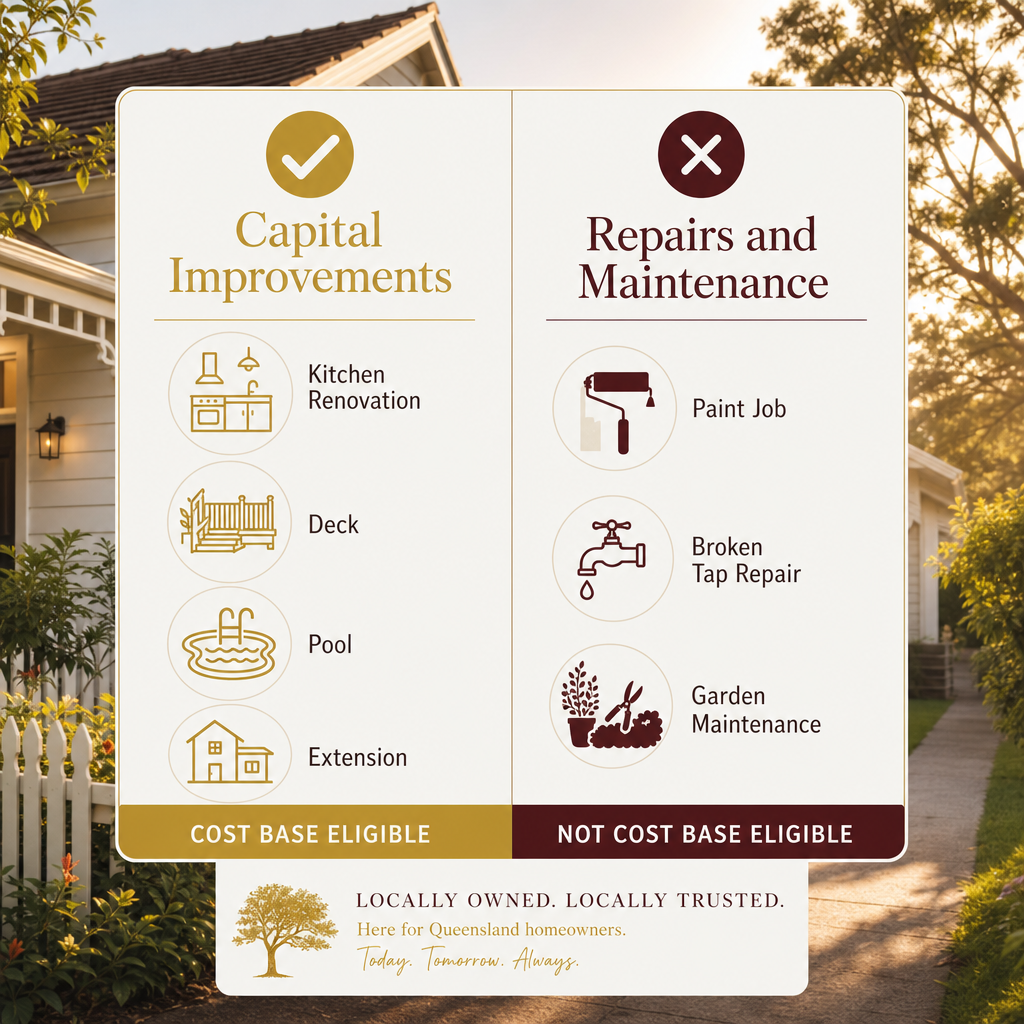
This is where many sellers leave money on the table. The cost base is not just your purchase price. Every capital improvement you made to the property can be added, and those additions directly reduce your taxable capital gain.
The distinction the ATO draws is between capital improvements (which go into the cost base) and repairs and maintenance (which are claimed as deductions for rental properties and therefore cannot also go into the cost base).
Capital improvements include:
- A new bathroom or kitchen (full replacement, not repair)
- An extension or additional room
- A new deck or outdoor structure
- Swimming pool installation
- Significant landscaping that adds a permanent improvement
- A new fence or retaining wall
- Solar panels or other substantial fixed installations
Repairs and maintenance that you have already claimed as deductions against rental income cannot be included in the cost base. This is double-dipping and the ATO treats it accordingly.
The practical implication is this: keep every receipt for every capital improvement you make from the day you purchase a property. If you are selling a property you have owned for 15 years, receipts from 2015 still matter. A $40,000 kitchen renovation from a decade ago reduces a taxable capital gain by $40,000, which at a 47 percent marginal rate saves you $18,800 in tax, or $9,400 after applying the 50 percent discount.
For investors who have held a property long-term and made significant improvements, a properly constructed cost base can dramatically reduce the final tax bill.
Timing Your Sale to Minimise Tax
Because CGT is assessed in the financial year the contract is exchanged (not when settlement occurs), the timing of your sale can significantly affect your tax outcome.
Here are the most practical timing strategies:
Split across two financial years
If you exchange contracts on 1 July rather than 30 June, the CGT liability falls into the next financial year. This may give you 12 months of tax deferral, and if your income is expected to be lower in the following year (for example, due to retirement or reduced work hours), your marginal rate may also be lower.
Hold for the 12-month threshold
If you are approaching the 12-month mark since purchase, waiting to sell until you cross that threshold can reduce your taxable capital gain by 50 percent. This is often worth more than any short-term market movement.
Offset gains with losses
If you hold other investments that are sitting at a loss, selling those assets in the same financial year as your property sale allows you to offset the losses against the capital gain. Capital losses from shares, managed funds, or other assets can be applied directly against property capital gains.
Consider income in the year of sale
If you are planning to sell in a year where you expect significantly higher income (a bonus, a large freelance contract, a redundancy payout), the added capital gain may push you into a higher bracket. In some cases, it is worth considering whether the sale could be structured differently or timed to a lower-income year.
None of these strategies should be implemented without professional advice, but they illustrate that the timing of a sale is a genuine financial decision, not just an administrative one.
Common CGT Mistakes Sellers Make
After years working in property across South East Queensland, I have seen the same CGT mistakes repeated across countless transactions. Here are the ones that cost sellers the most.
Assuming the main residence exemption is automatic
Many sellers assume that because a property was once their home, they are exempt from CGT. But if you rented it out, worked from it commercially, or owned it partly through a company or trust, the exemption is reduced or eliminated. Always verify your eligibility before assuming it applies.
Forgetting to adjust for depreciation claimed
Every dollar of building depreciation and plant and equipment depreciation you claimed as a tax deduction reduces your cost base. Sellers who claimed depreciation for years and then forget to account for it when calculating their gain are effectively underreporting their taxable capital gain, which creates compliance risk.
Not keeping capital improvement records
As I covered above, capital improvements increase your cost base and reduce your gain. Sellers who cannot substantiate those costs with receipts lose the deduction entirely. The ATO will not accept estimates.
Confusing the contract date with the settlement date
For CGT purposes, the relevant date is when contracts are exchanged, not when you receive the proceeds. Sellers who think they can defer a CGT liability by delaying settlement are often wrong. If contracts exchanged in June, the liability falls in the June financial year regardless of when settlement occurs.
Not considering the six-year rule
As I mentioned, this is the most underused concession. If you moved out of a property and never formally confirmed whether you were applying the six-year rule, you may have options you have not explored. Speak to a tax accountant before you sell a former home.
Selling within 12 months of purchase
This one is less a mistake and more a cost of necessity, but it is worth understanding. If circumstances force you to sell an investment property within 12 months of buying it, you pay tax on the full capital gain with no discount. In a market where property values have risen sharply, that full gain can be substantial.
When to Get Professional Advice
I will be direct here: CGT on property is one of the areas where professional advice consistently delivers a return greater than its cost. The calculations are detailed, the rules have genuine complexity, and the stakes are high enough that a mistake in either direction matters.
You should engage a qualified tax accountant or tax agent before selling if any of the following apply:
- The property has ever been used to produce income (rental or otherwise)
- You have claimed depreciation on the property
- The property is held in a trust, SMSF, or company structure
- You are dealing with an inherited property
- You have made significant capital improvements and need to verify what qualifies
- You are planning to sell and want to assess the timing options available to you
- The property was your main residence for only part of the ownership period
For property finance guidance specific to your situation, the team at George & Sons Finance can help you understand how a sale and any associated tax liability fits into your broader financial position. For those thinking about their next move after a sale, our real estate team can help you assess current market conditions and what a well-timed sale looks like in your suburb.
I started working with a developer in Beenleigh back in early 2021. He was sceptical at the start, straight up about it. He said to me: "I am not sure you can really do anything, but give it a go." Five years on, I have sold 12 apartments in that complex and we are still going. Part of what made that relationship work was taking the time to understand not just the property but the owner's broader situation, including the financial and tax implications of each sale. That approach applies whether you are a developer selling off the plan or an individual investor deciding whether now is the right time to exit. The details matter, and getting them right from the start is always worth it.
If you want personalised guidance on selling a property and how CGT applies to your specific circumstances, get in touch with the George & Sons team. We can connect you with the right professionals and help you make sense of your options before contracts are signed.
For a broader view of how the settlement process works once you do decide to sell, our guide on understanding the property settlement process in Australia is a useful companion to this article.
References
-
Australian Taxation Office, Capital Gains Tax on Property, The ATO's primary guidance on CGT as it applies to property, covering the main residence exemption, cost base rules, and the six-year absence rule. Available through the ATO website under the CGT section.
-
Australian Taxation Office, Cost Base of a CGT Asset, Detailed ATO guidance explaining the five elements of the cost base, including which expenses can be included and how depreciation deductions affect the cost base calculation.
-
Australian Taxation Office, Main Residence Exemption, Comprehensive ATO guidance on eligibility for the main residence exemption, partial exemption scenarios, and the conditions that apply when a property has been used to produce income.
-
Australian Taxation Office, Inherited Property and CGT, ATO guidance covering the CGT treatment of assets acquired through deceased estates, including the two-year exemption period for main residences and the cost base rules for pre- and post-CGT assets.
-
CoreLogic Annual Property Market Report 2026, CoreLogic's national residential property data tracking median prices, transaction volumes, and long-term capital growth across Australian capital cities and regional markets.
Get tailored guidance
Send us your question and we will reply within one business day.
Send us the article topic, suburb, or property goal you want help with and we will reply within one business day.
Send my questionFAQ
Do I pay CGT on my family home?
In most cases, no. Your primary residence is generally fully exempt from capital gains tax under the main residence exemption. However, the exemption does not apply automatically in all circumstances. If you used part of your home to produce income, claimed a home office deduction, or only lived in the property for part of the ownership period, the exemption may be partially reduced. The exemption also does not apply if the property is held in a company or most trust structures.
How is CGT calculated on a rental property?
Your capital gain is calculated by subtracting your cost base from your capital proceeds. The cost base includes the original purchase price, stamp duty, legal fees, agent commissions, and capital improvements. It is reduced by any depreciation you have previously claimed as a tax deduction. If you have owned the property for more than 12 months and are an Australian resident individual, you can apply the 50 percent CGT discount to halve the taxable gain. The resulting net capital gain is added to your taxable income for the year contracts were exchanged.
What expenses reduce my capital gain?
Expenses that form part of your cost base directly reduce your capital gain. These include the purchase price, stamp duty on purchase, legal and conveyancing fees on both purchase and sale, real estate agent commissions, title insurance, and capital improvements such as extensions, new kitchens, decking, or pools. Expenses you have already claimed as income tax deductions, including repairs, maintenance, and depreciation, cannot also be included in the cost base.
Does the six-year absence rule reset if I move back in?
Yes. If you move back into your former home and re-establish it as your main residence, the six-year clock resets when you next move out. You then have another six-year window during which you can rent the property out and still apply the main residence exemption. The key condition remains: you cannot have another property nominated as your main residence during the absence period.
How is CGT on inherited property handled?
The treatment depends on when the deceased originally acquired the property. If it was acquired before 20 September 1985, it is a pre-CGT asset and no CGT applies to the inheritance itself. Your cost base is set at market value at the date of death. If the property was acquired after that date and was the deceased's main residence, you may be fully exempt if you sell within two years of the date of death. For investment properties inherited from estates where the original acquisition was post-September 1985, your cost base is generally the market value at the date of death, and CGT applies to any gain you make from that point.
Can I offset capital losses against my property gain?
Yes. Capital losses from other assets, including shares, managed funds, or other investment properties sold at a loss, can be offset against your capital gain from a property sale. You apply losses before applying the 50 percent CGT discount. If your losses exceed your gains in a given year, the remaining losses are carried forward to future years. Capital losses cannot be offset against ordinary income such as wages or salary.
When is CGT due after settlement?
CGT is assessed in the financial year the contracts of sale are exchanged, not when settlement occurs. You report the capital gain in your individual tax return for that financial year, which is lodged either by 31 October for self-lodgement or by the extended deadline if you use a registered tax agent. The tax is due when your income tax assessment is issued. There is no separate CGT payment mechanism in Australia. It flows through your standard income tax assessment.
Does CGT apply to vacant land?
Yes, in most cases. Vacant land is a capital asset and CGT applies when you sell it. There is no main residence exemption for land that does not have a dwelling on it that you used as your home. If you purchased vacant land intending to build your main residence but sold it before the dwelling was completed, the exemption generally does not apply. The 50 percent CGT discount is available if you held the land for more than 12 months and are an eligible individual or trust.
Margy George
Property and finance guidance from the George & Sons team.
Keep reading
property management fees Australia
Property Management Fees in Australia: A Comprehensive Guide for Landlords
19 min read
real estate market trends Australia
35 Australian Real Estate Market Statistics for 2026
20 min read
rent vesting strategy australia
Rent-Vesting in Australia: The Strategic Property Investor's Guide for 2026
18 min read
Ready for clarity?
Get a calm, practical plan for your next property move.
Buying, selling, finance, or renting - tell us what you are working on and we will come back with the most useful next step.
Tell us what you need help with.
Send a quick enquiry and the team will come back with a clear next step.
Request a callback