real estate agent commission fees Australia
Real Estate Agent Commission Fees in Australia: What Sellers Actually Pay in 2026
Most sellers I speak with either assume agent fees are a flat, regulated amount, or they've heard a number from a neighbour and treat it as gospel. Neither approach serves them well. Real estate agent commission fees in Australia are unregulated, vary by state, and can differ by tens of thousands of dollars on a single property sale depending on how you structure the agreement and which agent you choose.
The cost of selling a home in Australia is not just the commission. Marketing, conveyancing, styling, and in some cases auction fees all sit on top. When you add everything up, the total selling cost on a median-priced home in a capital city can easily reach $25,000 to $40,000. Knowing exactly what you're paying for, and why, puts you in a far stronger position when you sit across the table from an agent.
This guide breaks down every component of agent fees, shows you real state-by-state rate comparisons, explains the difference between fee structures, and gives you the negotiation tools you need to make a confident decision. Whether you're selling in Brisbane, Sydney, Melbourne, or a regional suburb, the principles are the same: understand the fee, understand what it covers, and hold the agent accountable to both.
Key Takeaways
- Average real estate commission rates in Australia range from approximately 1.6% in NSW to around 3.0% in some regional Queensland and WA markets, with significant variation even within the same suburb.
- Commission is almost always calculated as a percentage of the final sale price and is typically paid from settlement proceeds, not upfront.
- Fixed-fee models exist and suit certain sellers, but they carry trade-offs around motivation and service depth that percentage models do not.
- The agent's commission is only one part of the total cost of selling. Marketing, conveyancing, styling, and auction fees can add $5,000 to $15,000 or more on top.
- Commission rates are fully negotiable in Australia. Most sellers who negotiate get a better rate, yet many never ask.
- Tiered and performance-based commission structures can align agent incentives with your goals and are worth exploring before you sign.
State-by-State Average Commission Rates (2026)
| State/Territory | Avg Commission Rate | Median House Price (approx.) | Approx. Commission on Median |
|---|---|---|---|
| New South Wales | 1.8% - 2.2% | $1,180,000 | $21,240 - $25,960 |
| Victoria | 1.6% - 2.5% | $890,000 | $14,240 - $22,250 |
| Queensland | 2.5% - 3.0% | $810,000 | $20,250 - $24,300 |
| Western Australia | 2.2% - 3.0% | $720,000 | $15,840 - $21,600 |
| South Australia | 1.9% - 2.5% | $720,000 | $13,680 - $18,000 |
| Tasmania | 2.0% - 2.75% | $590,000 | $11,800 - $16,225 |
| ACT | 1.75% - 2.25% | $850,000 | $14,875 - $19,125 |
| Northern Territory | 2.5% - 3.5% | $490,000 | $12,250 - $17,150 |
Note: Median price estimates are approximate and based on aggregated market data from early 2026. All figures are inclusive of GST. Actual commission is negotiable and will vary by suburb, property type, and agent.
How Real Estate Commission Works in Australia
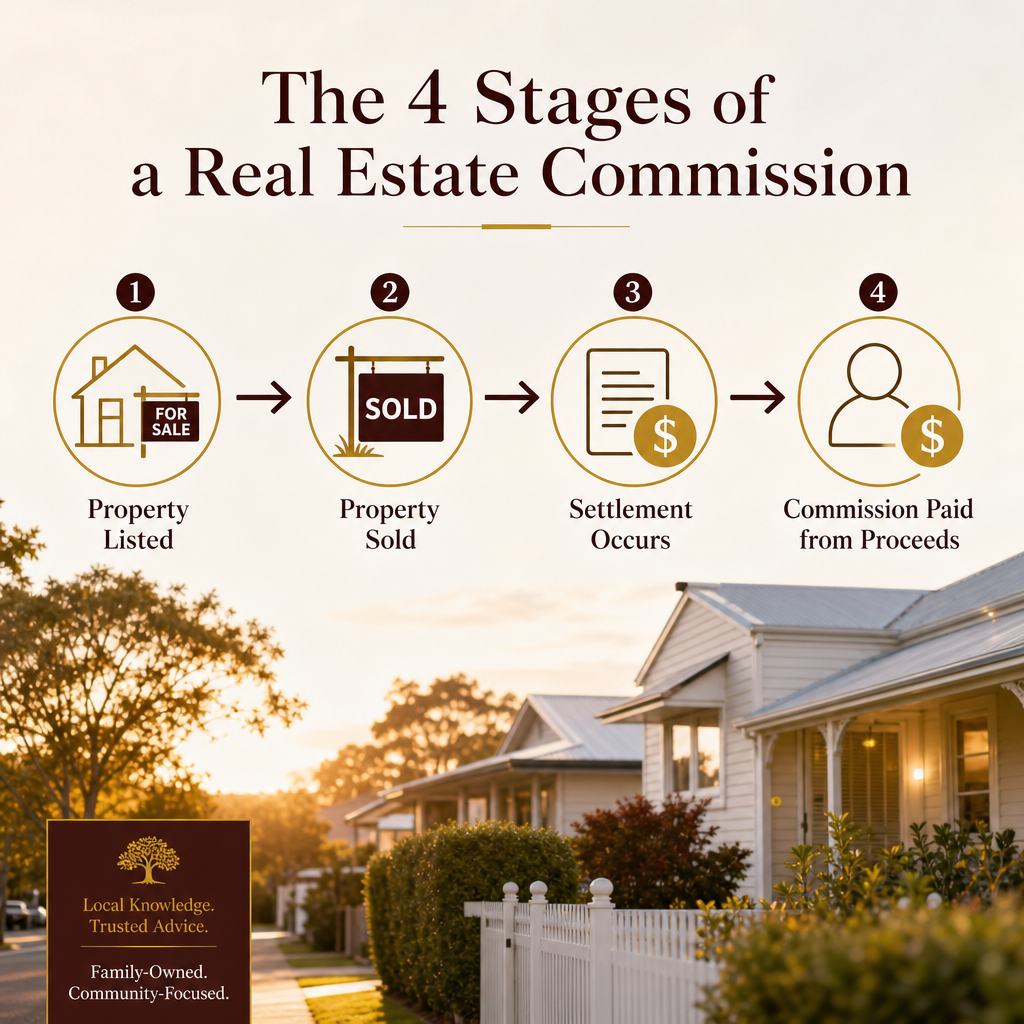
Real estate agent commission in Australia is the fee an agent earns for successfully selling your property. Unlike some countries where fees are set by government or industry bodies, Australia has no regulated commission rate. Every fee is a commercial agreement between you, the seller, and the agent you appoint.
The most common structure is a percentage of the final sale price. If your home sells for $800,000 and you've agreed on a 2.5% commission, your agent earns $20,000. That fee is paid at settlement, deducted from the sale proceeds by your conveyancer or solicitor. You don't write a cheque on the day you sign the agency agreement.
Who Sets the Commission?
The agent proposes a rate when they present their listing proposal. That rate is influenced by local market norms, the agent's experience and track record, the property type, and honestly, how much they want the listing. There is no industry minimum or maximum. The Real Estate Institute of Victoria (REIV), the Real Estate Institute of Queensland (REIQ), and their state equivalents publish guidance and conduct advocacy, but they do not set fees.
State fair trading bodies regulate the conduct of agents and the content of agency agreements. In Queensland, for example, the Office of Fair Trading requires that the commission amount, how it's calculated, and when it's payable must all be clearly stated in the Form 6 agency agreement before you sign. In NSW, the Property and Stock Agents Act 2002 governs disclosure requirements. The substance of those rules is similar across states: the fee must be disclosed in writing, and you must agree to it before the agent acts on your behalf.
When Is Commission Paid?
In almost all cases, commission is paid at settlement from the sale proceeds. Your conveyancer receives the settlement funds, pays out the mortgage, pays the agent, and remits the balance to you. You typically never handle the commission payment directly.
There are edge cases. If you terminate an agency agreement after the agent has performed substantial work, a reduced fee may be payable. Some agreements also contain a "continuing agency" clause, meaning if you sell to a buyer the agent introduced within a certain period after the agreement ends, commission is still owed. Read those clauses carefully before you sign.
Is GST Included?
Commission rates are almost always quoted inclusive of GST. A 2.5% commission on an $800,000 sale is $20,000 including GST. The underlying commission before GST is approximately $18,182, with $1,818 in GST on top. Always confirm whether a quoted rate is GST-inclusive or exclusive. Most agents quote inclusive figures, but it's worth asking directly.
Average Commission Rates by State in 2026
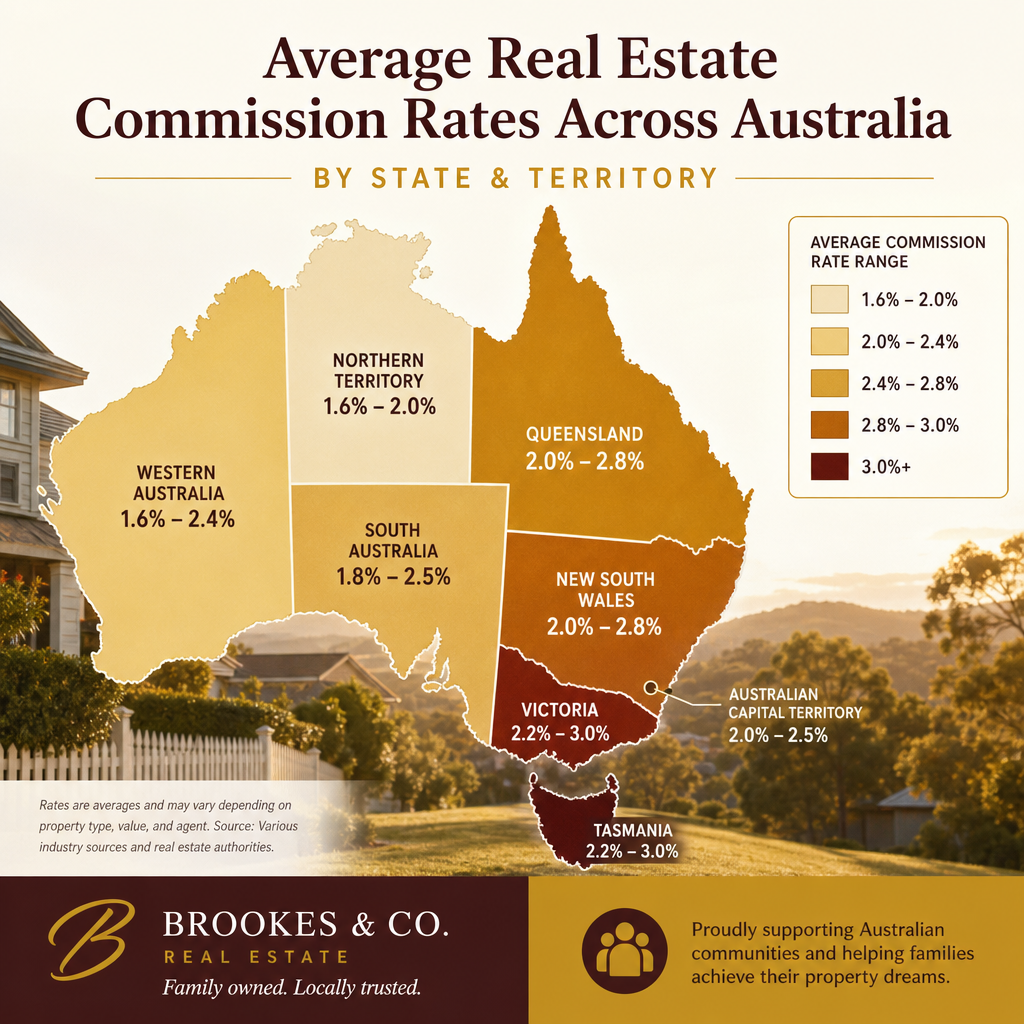
The table above gives you a snapshot, but the numbers deserve more context. Commission rates in Australia follow a broadly inverse relationship with median property prices. States and territories with higher property values tend to have lower percentage rates, because the dollar return to the agent is still substantial on a smaller percentage. Queensland and Western Australia, where median prices are lower than Sydney or Melbourne, tend to attract higher percentage rates.
New South Wales
Sydney and its surrounds have some of the lowest percentage commissions in the country, driven by fierce agent competition and high property values. In inner Sydney suburbs, rates of 1.5% to 1.8% are common. Move to outer western Sydney or regional NSW and you'll see rates climb to 2.2% to 2.5%. The high transaction values mean even a 1.8% rate on a $1.5 million home represents a $27,000 commission, which is more than adequate for a full-service agent.
Victoria
Melbourne agents are similarly competitive on rates. Inner-city and inner-suburb agents often quote 1.6% to 2.0%. In regional Victoria, Ballarat, Bendigo, and the Latrobe Valley, you'll see 2.2% to 2.75%. One thing that distinguishes the Melbourne market is the prevalence of auction as the primary selling method, which can affect how marketing fees are structured alongside commission.
Queensland
Queensland operates under a percentage-of-sale-price norm that typically sits higher than the southern states. Southeast Queensland, including Brisbane, the Gold Coast, and the Sunshine Coast, sees rates between 2.5% and 3.0%. For regional areas, some agents quote tiered structures (more on that shortly) where the first tranche of the sale price attracts one rate and the amount above a threshold attracts a higher rate.
At George & Sons, we operate primarily across southeast Queensland and we're transparent about where rates sit in this market and why. Our fee conversations happen before you sign anything.
Western Australia
Perth and surrounding suburbs have seen significant price growth in recent years, which has put some downward pressure on percentage rates as agents' dollar earnings have increased. You'll still see 2.2% to 2.75% quoted for most Perth metro properties. Regional WA, where transactions are less frequent and properties can be harder to sell, may see rates up to 3.5%.
South Australia, Tasmania, ACT, and Northern Territory
South Australia rates tend to cluster around 2.0% to 2.5% in Adelaide, with regional SA slightly higher. Tasmania's market is smaller and agents typically quote 2.0% to 2.75%. The ACT, being a compact, highly educated market with significant public service employment, tends toward the lower end of the national range, often 1.75% to 2.25%. The Northern Territory has the highest typical rates in the country, reflecting the challenges of a thin, geographically dispersed market.
Fixed Fee vs Percentage Commission: Pros and Cons
Over the past decade, fixed-fee or low-cost online agency models have grown in Australia. Platforms like those offering flat fees of $3,000 to $8,000 appeal to sellers who want to control costs. But the decision between fixed and percentage commission deserves serious analysis, not a reflexive choice based on the dollar amount alone.
How Fixed-Fee Agents Work
A fixed-fee agent charges a set dollar amount regardless of the final sale price. Some models charge the fee upfront, meaning you pay whether the property sells or not. Others charge on success only. Typically these models include a listing on realestate.com.au and Domain, a set number of photos, and limited in-person support. Negotiation, open home management, and buyer follow-up may be reduced or optional extras.
The Motivation Problem
Here's the fundamental tension with fixed-fee models: if an agent earns the same $5,000 whether your home sells for $750,000 or $820,000, where does their commercial incentive lie? It lies in volume, signing as many listings as possible and processing them efficiently. That's not a criticism of the people involved; it's a structural reality.
A percentage-based agent who negotiates your price from $750,000 to $820,000 earns an additional $1,750 on a 2.5% commission. That's not a huge reward for a skilled negotiation that put an extra $70,000 in your pocket, but it does mean their interests are directionally aligned with yours. With a fixed fee, that alignment doesn't exist.
When Fixed Fee Makes Sense
Fixed-fee models can work well when: the property is in a high-demand area where it will sell quickly regardless of negotiation effort, the seller is experienced and willing to handle some of the process themselves, the property is straightforward with clear comparable sales, and the seller's primary goal is cost minimisation rather than price maximisation.
They're generally not the right choice for unique or prestige properties, distressed sales where negotiation is critical, properties with title or body corporate complexity, or sellers who are time-poor and need a full-service experience.
The Percentage Model's Accountability
A percentage commission gives you leverage. If an agent quotes 2.5% and you're not satisfied with their open home attendance, their follow-up with buyers, or their communication, you have a fee structure that justifies demanding more. You're not paying a transaction-processing fee; you're paying for advocacy. Hold them to it.
| Factor | Percentage Commission | Fixed Fee |
|---|---|---|
| Agent incentive to maximise price | High (earns more on higher sale) | Low (same fee regardless) |
| Typical upfront cost | Nil (paid at settlement) | Sometimes payable upfront |
| Service depth | Usually full-service | Variable, often limited |
| Suitable for complex properties | Yes | Generally no |
| Negotiation leverage for seller | Yes | Limited |
| Risk if property doesn't sell | Usually nil (no-sale no-fee) | Risk of upfront fee loss |
What Is Included in an Agent's Commission
This is where many sellers get a nasty surprise. In most cases, the commission covers the agent's time and expertise, specifically the appraisal, listing preparation, open home management, buyer enquiry handling, negotiation, and contract management through to settlement. It does not automatically include marketing.
What Commission Typically Covers
- Property appraisal and comparative market analysis
- Preparation of the listing, including liaison with photographers and copywriters (though photography itself may be separate)
- Listing on realestate.com.au and Domain
- Management of open homes and private inspections
- Buyer enquiry and follow-up
- Price negotiation and offer management
- Liaison with your conveyancer or solicitor through to settlement
- Ongoing communication with you as the vendor
What Is Usually Not Included
- Professional photography (typically $300 to $800)
- Floorplan creation ($150 to $350)
- Copywriting beyond basic listing text (sometimes extra)
- Signboard ($200 to $500)
- Marketing upgrades on realestate.com.au or Domain (Premiere Property listings, Highlight listings, etc.)
- Auction fees if selling by auction ($400 to $1,000 for the auctioneer)
- Vendor-paid advertising (VPA) budgets for print, social media, and digital campaigns
- Property styling or staging
- Pre-sale repairs or maintenance coordination (though many good agents will help organise this)
We've written in detail about how vendor-paid advertising works and when it's worth the investment in our guide to understanding vendor-paid advertising when selling property. Short version: the marketing budget comes out of your pocket, not the agent's commission, and it matters significantly for exposure and result.
Additional Selling Costs Beyond Commission
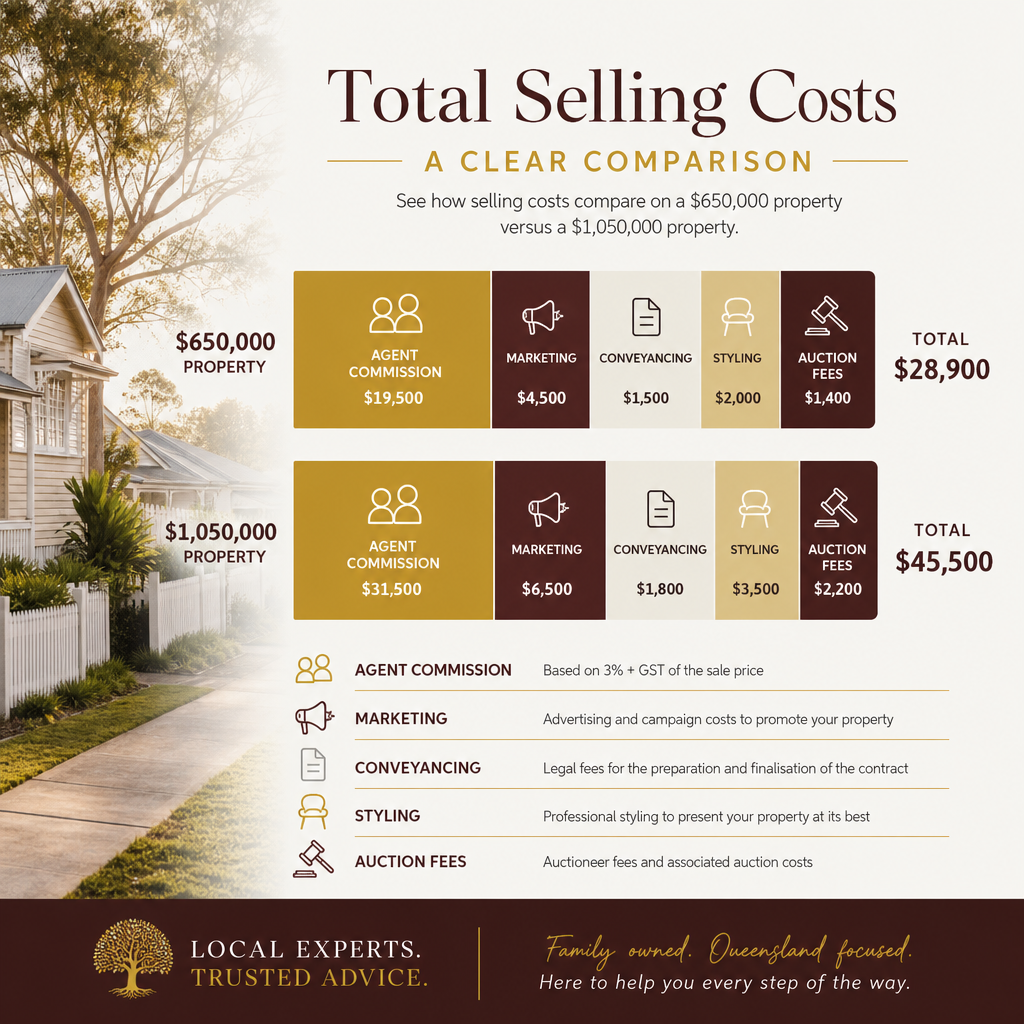
To make a fully informed decision about the cost of selling, you need to look at the complete picture. Commission is the largest single fee, but it's rarely the only one.
Marketing and Advertising
A typical marketing campaign for a southeast Queensland home in 2026 might include:
- Professional photography: $400 to $700
- Floorplan: $200 to $300
- Signboard: $250 to $400
- realestate.com.au Premiere listing (4 weeks): $900 to $2,200 depending on suburb
- Domain feature listing: $400 to $900
- Social media advertising (Facebook, Instagram): $500 to $1,500
- Print media (if applicable): $500 to $2,000
Total marketing spend for a well-run campaign: $3,000 to $8,000, sometimes more for prestige properties.
Conveyancing and Legal Fees
You will need a conveyancer or solicitor to prepare the contract of sale, manage the transfer, and handle settlement. In Queensland, conveyancing fees for a straightforward residential sale typically range from $800 to $1,500. In NSW, the range is similar. Complex titles, body corporate involvement, or off-the-plan elements will increase costs.
Property Styling
Professional styling, where furniture and décor are brought in to present the property at its best, can cost $2,000 to $8,000 for a standard home depending on the number of rooms and the duration of the campaign. Research consistently shows that styled properties sell faster and often for more, but the cost is real and should be factored into your budget.
Auction Fees
If you choose to sell by auction, the auctioneer's fee is typically separate from the agent's commission. Expect $400 to $1,000 for the auctioneer. Some agents include this within their overall fee; others itemise it separately. Ask the question before you sign.
Capital Gains Tax
For investors and those selling a non-primary residence, capital gains tax is a significant cost that sits entirely outside the agent's fee. We've covered this in detail in our guide to capital gains tax when selling property in Australia. Speak to your accountant before you sell, not after.
Case Study 1: Brisbane Townhouse Sale
A client came to us with a three-bedroom townhouse in a well-regarded southeast Queensland suburb. The agreed commission was 2.5% (inclusive of GST). Here's what the total cost of selling looked like:
- Agent commission (on $685,000 sale): $17,125
- Marketing campaign (photography, signboard, REA Premiere, social): $4,200
- Conveyancing: $1,100
- Property styling (lounge, master bedroom, outdoor area): $3,400
- Total selling costs: $25,825
- Net proceeds after costs (before mortgage payout): $659,175
The property sold 11 days after listing. The vendor had initially quoted a buyer who enquired privately at $650,000 before engaging us. The final sale price was $685,000. The $35,000 uplift comfortably covered the entire cost of selling.
Case Study 2: Beenleigh Apartment Complex
I want to share a situation that taught me something valuable about the relationship between fee conversations and long-term trust.
In early 2021 I was referred to the owner of a newly built apartment complex in Beenleigh. When I arrived for the appraisal, the owner was direct: he wasn't sure a smaller agency could make a difference, especially with larger agencies also pitching for the work. His words were something like, "Give it a go, but I'm not confident."
I made sure I knew the complex inside and out, from the body corporate structure to the individual apartment configurations. When I walked buyers through, I wasn't reciting a brochure. I understood what they were actually looking for and could speak to it honestly. The first apartment sold. Then the second. By 2026, we've sold 12 apartments in that complex and the owner and I are now genuinely good friends.
The fee conversation was straightforward from the start. I quoted what the market supported, explained exactly what was included, and delivered on it. Five years on, that transparency has been worth far more than any single commission. The point is this: the right agent at a fair fee, who knows their product and takes genuine interest in buyers, will outperform a cheap agent who treats the listing as a number in a spreadsheet.
How to Negotiate Agent Fees Without Sacrificing Service Quality
Negotiating commission is expected. Most agents price in room to negotiate, and the fact that you're asking does not damage the relationship if you do it respectfully. Here's how to do it properly.
Know Your Market Rate First
Before you sit down with an agent, understand what comparable properties in your suburb have sold for and what rates agents typically charge locally. Speaking to two or three agents gives you a sense of the range. If everyone is quoting 2.5% and one agent quotes 2.0%, ask why. It might be a reflection of genuine confidence or it might signal a service compromise.
Compare Total Packages, Not Just the Percentage
An agent quoting 2.0% who charges separately for photography, signboards, and premium listings may cost more in total than an agent quoting 2.5% who includes those items. Always ask for a full cost breakdown so you're comparing apples with apples.
Ask About Tiered Structures
A tiered commission structure rewards the agent for achieving a price above a threshold you agree on. For example: 2.0% on the first $700,000 and 10% on anything above $700,000. This model, which we'll explain in more detail shortly, aligns incentives strongly and can make the fee conversation less adversarial.
Use Competing Quotes Carefully
You can use a competing quote as leverage, but do it with integrity. If Agent A has quoted 2.5% and Agent B has quoted 2.0%, and you prefer Agent A, tell them. Ask if they can meet or move toward the lower quote. Most will negotiate. Don't fabricate competing offers or misrepresent what you've been quoted.
Don't Negotiate to the Point of Resentment
I've seen sellers push so hard on the fee that the agent accepts reluctantly and then delivers a minimal-effort campaign. The agent is still getting paid, just less, and their motivation reflects that. A reasonable negotiation that lands at a mutually acceptable figure will serve you better than an aggressive negotiation that wins on paper but loses in execution.
What You Can Ask for Instead of a Lower Rate
If an agent won't move on the percentage, negotiate the inclusions. Ask for the premium listing upgrade to be included. Ask for the signboard. Ask for a shorter exclusive agreement period so you have the option to switch if results aren't coming. These concessions have real dollar value and don't require the agent to sacrifice their baseline fee.
Tiered and Performance-Based Fee Structures Explained
Performance-based and tiered commission structures are common in Queensland and increasingly used elsewhere. They deserve a proper explanation because they're often misunderstood.
How a Tiered Structure Works
A tiered structure sets a base commission rate on the expected sale price, then applies a higher rate on any amount above an agreed reserve or threshold. Example:
- 2.0% on the first $750,000
- 10% on any amount above $750,000
If the property sells for $750,000, the agent earns $15,000. If it sells for $800,000, the agent earns $15,000 plus $5,000, totalling $20,000. The seller gets an extra $45,000 for $5,000 more in commission. That's a strong incentive alignment.
In Queensland, tiered structures must be disclosed in the Form 6 agency agreement. The threshold price and both rates must be clearly stated. Never agree to a tiered structure unless you understand exactly what the threshold is and how the calculation works.
Performance Bonuses
Some agents propose a standard flat commission plus a performance bonus if the property sells above a certain price or within a certain timeframe. These can work, but they need to be scrutinised. Make sure the threshold is set at a genuinely ambitious but achievable price based on comparable sales data, not at a level so easy to exceed that the bonus is almost guaranteed.
When These Structures Work Best
Tiered and performance-based structures work best when: the property has genuine upside potential and comparable sales show a wide range, you want the agent to stretch for a premium result rather than bank a quick sale, and both parties have agreed on a realistic but ambitious price threshold.
They're less suitable for highly commoditised properties in tight price ranges where the comparable sales evidence is very consistent.
Red Flags in Agent Fee Agreements
Most agency agreements are straightforward, but there are clauses and practices that warrant close attention. Our guide to how to choose a real estate agent to sell your home covers the broader agent selection process, but here are the specific fee-related red flags.
Excessive Exclusive Agency Periods
In Queensland, the standard exclusive agency period for residential property is 60 to 90 days. Some agents push for longer, up to 180 days. A longer exclusive period means you're locked in even if the agent underperforms. Negotiate a 60-day exclusive period with an option to extend if you're satisfied with the progress.
Continuing Agency Clauses
Almost all agency agreements include a continuing agency clause, which means if a buyer introduced by the agent purchases the property within a specified period after the agreement ends (often 30 to 90 days), commission is still payable. This is fair and legal. The red flag is a continuing agency period that extends beyond 90 days, which is excessive.
Upfront Marketing Fees with No Sale Guarantee
Some agents, particularly those using higher-volume models, require marketing fees paid upfront as vendor-paid advertising. This is standard and legitimate. What's not acceptable is an agent who requires a large non-refundable upfront payment that doesn't come back to you if the property fails to sell. Understand the refund policy on marketing spend before you commit.
Commission Rates Not Stated in Writing
This sounds obvious but it happens. If an agent quotes a rate verbally during the listing presentation and then the written agency agreement contains a different (higher) rate, that's a serious problem. Read every line of the Form 6 (Queensland), agency agreement (NSW), or equivalent document before signing. The written agreement governs; verbal representations do not.
Pressure to Sign Immediately
A good agent will give you time to read the agreement, ask questions, and compare proposals. An agent who pressures you to sign on the spot during the listing presentation is prioritising their pipeline over your interests. Walk away and take 24 to 48 hours minimum.
How George & Sons Approaches Transparent Pricing
At George & Sons, our approach to fee conversations is direct. We quote a rate that reflects our expertise, the work involved, and the local market. We explain exactly what's included and what isn't. We don't hide the marketing costs in the commission or inflate the commission to absorb costs we should be disclosing separately.
We operate across southeast Queensland and our fee structure reflects the market norms of this region. Where a tiered commission structure is in our client's interest, we'll recommend it. Where a flat percentage better suits the property and timeline, we'll go that route. The goal is always the same: maximum net proceeds for the seller, not maximum commission for us.
What Our Vendors Say
"I'd spoken to three agents before I met with George & Sons and none of them could clearly answer what was included in their fee. The George & Sons conversation was completely different. They laid out the commission, the marketing budget, what each line item covered, and what my likely net proceeds would be at different sale prices. That kind of clarity made the decision easy.", Vendor, Beenleigh, 2025
Our Fee Promise
Every vendor we work with receives a written fee breakdown before we ask them to sign anything. The breakdown includes the commission rate and dollar amount at the expected sale price, all marketing costs, an estimate of conveyancing fees, and a projected net proceeds figure. We think you deserve to know your numbers before you commit, not after settlement.
If you'd like a no-obligation fee breakdown for your property, get in touch with our team here. We'll give you honest numbers and an honest conversation about what your property is worth in today's market.
Putting It All Together: Total Cost of Selling Scenarios
To give you a fully grounded picture, here are two total selling cost scenarios that reflect southeast Queensland market conditions in 2026.
Scenario A: $650,000 House, Standard Campaign
- Agent commission at 2.5%: $16,250
- Marketing (photography, REA Premiere, signboard, social): $3,800
- Conveyancing: $1,000
- Styling (partial): $2,200
- Total selling cost: $23,250
- Net proceeds before mortgage payout: $626,750
Scenario B: $1,050,000 House, Premium Campaign
- Agent commission at 2.25%: $23,625
- Marketing (full premium campaign including print and digital): $7,500
- Conveyancing: $1,400
- Full staging: $5,500
- Auction fee: $700
- Total selling cost: $38,725
- Net proceeds before mortgage payout: $1,011,275
In both scenarios the agent commission is the largest single cost but is comfortably outweighed by the likely value of professional representation. The question is never "how do I avoid paying commission?" The question is "which agent is worth paying, and at what rate?"
References
-
Real Estate Institute of Victoria (REIV), Market Data and Commentary, The REIV publishes regular data on Victoria's property market, agent conduct standards, and industry guidance. Their materials are referenced for Victorian commission norms and agency agreement requirements.
-
REA Group / realestate.com.au, Agent Advice Section, REA Group's consumer-facing advice platform covers commission structures, agent selection, and selling guides relevant to all Australian states. Referenced for national commission rate context and listing fee structures.
-
Domain Group, Selling Guide and Market Data, Domain's research and editorial team publish detailed state-by-state breakdowns of selling costs and agent fee expectations. Referenced for complementary commission rate data.
-
Australian Bureau of Statistics (ABS), Housing Finance and Residential Property Price Indexes, ABS data underpins median property price estimates and housing market statistics cited in the state-by-state commission table. The Residential Property Price Indexes publication (cat. 6416.0) is the primary reference.
-
Queensland Office of Fair Trading, Real Estate Agency Agreements Guide, The Queensland OFT publishes plain-language guidance on Form 6 agency agreements, disclosure requirements, commission structures, and vendor rights. Referenced for Queensland-specific regulatory requirements including tiered commission disclosure obligations.
-
NSW Fair Trading, Property and Stock Agents Act 2002 (and associated regulations), NSW Fair Trading's guidance on agent conduct, commission disclosure, and agency agreement requirements. Referenced for NSW-specific regulatory context around fee disclosure and continuing agency clauses.
Get tailored guidance
Send us your question and we will reply within one business day.
Send us the article topic, suburb, or property goal you want help with and we will reply within one business day.
Send my questionFAQ
Is GST included in real estate agent commission?
In almost all cases, yes. When an agent quotes a commission rate in Australia, that rate is quoted inclusive of GST unless they explicitly state otherwise. Always confirm this at the time of the listing presentation. If an agent quotes 2.5%, the total fee on an $800,000 sale is $20,000, of which approximately $1,818 is GST. Your agent should provide a tax invoice at settlement that separates the base fee from the GST component.
When do I actually pay the agent's commission?
Commission is almost always paid at settlement from the sale proceeds. Your conveyancer or solicitor handles the distribution of funds at settlement: the mortgage is discharged, the agent is paid, and the remaining balance is transferred to you. You do not pay commission upfront or out of pocket separately. The only exception is if you have a fixed-fee upfront model, which requires payment before or during the listing period regardless of whether the property sells.
Can I negotiate the commission rate?
Absolutely, and you should. Commission rates in Australia are not regulated and are entirely negotiable. Most agents price in room to negotiate. The key is to negotiate intelligently: compare total packages including marketing inclusions rather than just the percentage, consider whether a tiered structure might serve you better than a flat rate, and be reasonable in your expectations. Negotiating too aggressively can result in a reluctant agent who delivers less than their best effort.
Does using an exclusive listing agent cost more than an open listing?
Not necessarily more in commission rate, but there are real differences in practice. An exclusive agency agreement means only one agent has the right to sell your property for the agreed period. An open listing means multiple agents can introduce buyers, and only the agent who introduces the successful buyer gets paid. In theory, open listings sound good because multiple agents are working for you. In practice, agents invest far less effort in open listings because they may not be paid for their work. Exclusive listings consistently attract better agent effort, better marketing investment, and often better outcomes.
Do cheaper agents achieve lower sale prices?
Not always, but the risk is real. A lower commission does not automatically mean a lower sale price, and a higher commission does not guarantee a better result. What matters is the agent's skill at negotiation, their local buyer database, their marketing capability, and their follow-through. A highly capable agent at 2.5% who runs a strong campaign and negotiates firmly will almost certainly outperform a cheaper agent who runs a minimal campaign and takes the first offer. Before choosing an agent based on fee alone, ask them to provide evidence of their recent sale prices relative to asking prices and their days-on-market statistics.
What happens if my property doesn't sell?
If your property does not sell within the agency agreement period, you generally owe no commission. This is the standard no sale, no fee structure that applies to the vast majority of Australian residential sales. You may still be liable for marketing costs that were incurred, depending on the terms of your agreement. Some agents offer to absorb marketing costs if the property doesn't sell; others do not. Ask the question clearly before you commit.
Are there any other fees I should know about beyond commission and marketing?
Yes. Beyond commission and marketing, the main additional costs are conveyancing or solicitor fees ($800 to $1,500 for a standard residential sale), property styling if applicable ($2,000 to $8,000), auction fees if selling by auction ($400 to $1,000 for the auctioneer), and potentially a building or pest inspection report. If you are selling an investment property or a home that is not your primary residence, capital gains tax is a significant cost that sits entirely outside the agent's fee.
How do I know if an agent's quoted commission is fair?
Fairness is relative to the local market, the property type, and what the agent is offering in return. To assess it properly: speak to at least two or three agents so you have a comparison set, ask each agent for a full itemised breakdown of commission and marketing costs, check the agent's recent sold results on realestate.com.au or Domain to see their actual performance, and consider whether their quoted rate sits within the typical range for your state. In southeast Queensland, rates between 2.5% and 3.0% are standard.
Margy George
Property and finance guidance from the George & Sons team.
Keep reading
property settlement process australia
Understanding the Property Settlement Process in Australia: What Sellers Need to Know
25 min read
how to choose a real estate agent
How to Choose a Real Estate Agent to Sell Your Home in Australia
23 min read
best real estate agency
Best Real Estate Agency in Australia: What Sets Top Agencies Apart
19 min read
Ready for clarity?
Get a calm, practical plan for your next property move.
Buying, selling, finance, or renting - tell us what you are working on and we will come back with the most useful next step.
Tell us what you need help with.
Send a quick enquiry and the team will come back with a clear next step.
Request a callback