cost of selling a house in Australia
The True Cost of Selling a House in Australia: A Complete Breakdown for 2026
Most sellers walk into the market focused on one number: what their property will sell for. What catches them off guard is everything that comes out before they see a cent. In my experience working with vendors across South East Queensland, the gap between expected and actual net proceeds is often $15,000 to $40,000. That gap is not accidental. It is the result of costs that are real, predictable, and almost always underestimated.
The total cost of selling a house in Australia in 2026 typically sits between 2.5% and 5.5% of the sale price. On a $900,000 property, that means $22,500 to $49,500 leaving your pocket before settlement. Some of those costs are compulsory. Some are discretionary but strategically important. And a few, like capital gains tax, can dwarf everything else combined if you are not prepared. This guide breaks every one of them down, with real cost ranges, state-by-state context, and a worked example so you know exactly what to expect.
Whether you are selling your first home or your tenth investment property, the goal here is simple: no surprises at settlement. Let us go through it cost by cost.
Key Takeaways
- The total cost of selling a house in Australia typically ranges from 2.5% to 5.5% of the sale price, covering agent commission, marketing, legal fees, presentation costs, and more.
- Agent commission is usually the single largest selling cost, ranging from 1.5% to 3.5% of the sale price depending on the state, agent, and property type.
- Marketing and advertising costs (vendor paid advertising, or VPA) range from $2,000 to $15,000 and directly affect how many buyers see your property.
- Conveyancing, Section 32 preparation, auction fees, mortgage discharge, and pre-sale presentation all add up quickly and are often overlooked.
- Capital gains tax (CGT) is not a selling cost per se, but it can be the biggest financial impact of a sale for investment property owners and must be factored into your net proceeds calculation.
- Getting a clear, itemised cost estimate before you list is the single best thing you can do to protect your financial outcome.
Summary: Selling Cost Categories at a Glance
| Cost Category | Low Estimate | High Estimate | Notes |
|---|---|---|---|
| Agent Commission | $9,000 | $31,500 | 1.5%-3.5% of sale price |
| Vendor Paid Advertising (VPA) | $2,000 | $15,000 | Varies by market and campaign |
| Conveyancing / Legal Fees | $800 | $2,500 | Vendor-side only |
| Section 32 / Vendor Statement | $300 | $800 | Victoria-specific but similar elsewhere |
| Auction Fees | $400 | $1,500 | If selling by auction |
| Property Styling / Staging | $2,000 | $10,000 | Partial to full staging |
| Pre-Sale Repairs and Presentation | $500 | $15,000 | Highly variable |
| Building and Pest Report | $400 | $1,000 | Sometimes vendor-commissioned |
| Mortgage Discharge Fee | $150 | $1,500 | Lender-specific |
| Capital Gains Tax | $0 | $100,000+ | Depends on property type and ownership |
| Estimated Total (ex-CGT) | $15,350 | $77,800 | On a $900k property |
All figures are estimates for illustrative purposes. Actual costs depend on your location, property, agent, and individual circumstances.
Agent Commission: Your Largest Single Cost
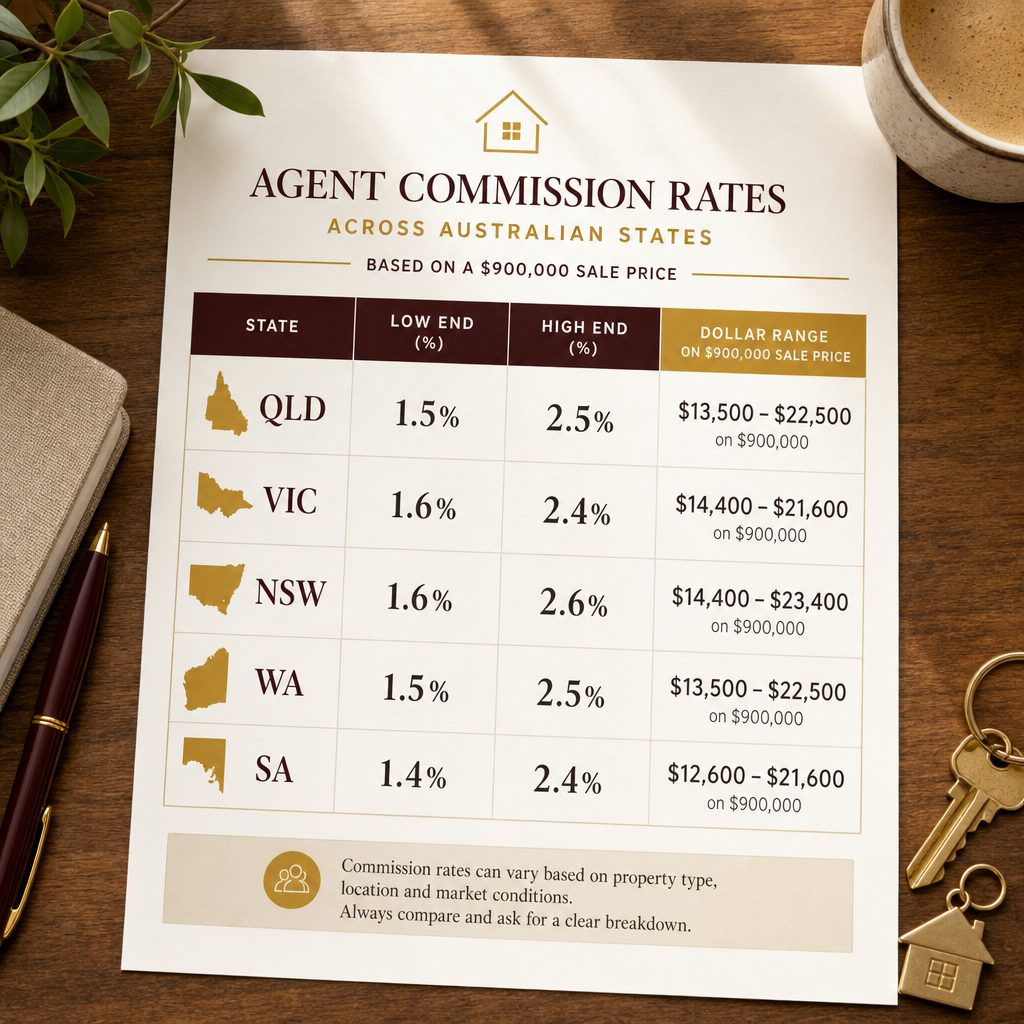
Real estate agent commission is almost always the biggest line item when you sell. In Australia, commission is calculated as a percentage of the final sale price and is paid by the vendor at settlement. It covers the agent's time, negotiation, open home management, buyer communication, and ongoing campaign management from listing to contract.
What Commission Rates Look Like Across Australia
Commission rates vary significantly by state and by market. Here is a realistic 2026 breakdown:
- Queensland: 2.5% to 3.5% is typical, with some regional agents operating at the higher end.
- Victoria: Generally 1.6% to 2.5%, with Melbourne inner suburbs closer to 2%.
- New South Wales: Often 1.5% to 2.5% in metro areas, with regional NSW trending higher.
- Western Australia: Commission is capped by the Real Estate and Business Agents Act at 3.3% on the first $18,000 and 1.65% thereafter, though negotiated rates are common.
- South Australia: Typically 1.5% to 2.75%.
- ACT: Around 2% to 2.75%.
On a $900,000 sale, a 2.5% commission equals $22,500. At 3%, that is $27,000. The difference between an average commission and a premium commission is real money, which is why understanding what you get for the rate matters as much as the rate itself.
Some agents quote a flat fee. These can appear attractive, but a flat-fee agent who does not negotiate hard on your behalf could cost you far more than the commission saving. A skilled negotiator who earns 2.5% but achieves $30,000 more than a flat-fee competitor has more than paid for their rate.
For a deeper look at how commission structures work and how to evaluate them, read our guide on understanding real estate agent commission fees in Australia.
Can You Negotiate Commission?
Yes. Commission is not fixed by law in most states (Western Australia is a partial exception). That said, negotiating commission aggressively can backfire. An agent who agrees immediately to drop their fee by 0.5% may be signalling that they do not negotiate hard generally. The best agents typically hold their rate because they know what their service delivers. Negotiate on what is included in the campaign, not just the rate.
Vendor Paid Advertising: The Marketing Budget That Sells Your Home
Vendor paid advertising, or VPA, is the cost of promoting your property to buyers. It is separate from commission and covers listing placements on portals like realestate.com.au and Domain, professional photography, copywriting, signboards, floorplans, social media promotion, and in some cases print media.
What Does VPA Actually Cost?
A basic VPA package in a regional or outer-suburban market might run $2,000 to $4,000. In competitive metropolitan markets, particularly for properties above $800,000, a well-structured campaign typically costs $5,000 to $10,000. Prestige properties or those requiring extended campaigns can push past $15,000.
Here is a typical VPA breakdown for a South East Queensland residential sale in 2026:
- Professional photography and video: $600 to $1,500
- realestate.com.au Premiere+ listing: $1,200 to $2,500 (duration dependent)
- Domain listing: $400 to $900
- Social media advertising (Facebook/Instagram targeting): $500 to $1,500
- Signboard: $200 to $500
- Floorplan: $150 to $350
- Copywriting and listing preparation: often included in agent fee
Total: $3,050 to $7,250 for a well-presented suburban campaign.
Is VPA Worth It?
The short answer is yes, when it is structured correctly. Buyer competition drives price. Buyer competition requires buyer awareness. An undermarketed property attracts fewer inspections, fewer offers, and weaker negotiating dynamics. I have seen vendors save $3,000 on a VPA package and lose $20,000 on the sale price because the property sat on market too long and buyers sensed weakness.
For a full breakdown of how VPA works and how to evaluate a campaign proposal, see our article on understanding vendor paid advertising when selling property.
Conveyancing and Legal Fees
Conveyancing is the legal process of transferring property ownership from vendor to buyer. As a seller, you need a solicitor or licensed conveyancer to prepare the contract of sale, respond to requisitions, and manage the settlement process.
What Do Vendor Conveyancing Fees Cost?
For a standard residential sale in Australia, vendor-side conveyancing fees typically fall between $800 and $2,500. The range depends on the complexity of the transaction, the state you are selling in, and whether you use a solicitor or a licensed conveyancer.
Some conveyancers charge a flat fee. Others charge on a time basis. In Victoria and Queensland, solicitors tend to handle both the legal and conveyancing components. In NSW and WA, licensed conveyancers are commonly used for standard transactions.
Do not choose your conveyancer purely on price. A $1,000 conveyancer who misses a special condition or delays settlement can cost you far more than the saving.
Section 32 / Vendor Statement Costs
In Victoria, every vendor must provide a Section 32 Vendor Statement to the buyer before a contract is signed. This document discloses title details, outgoings, zoning, building permits, and any encumbrances on the property. Preparation typically costs $300 to $800 and is usually handled by your conveyancer or solicitor as part of their overall fee.
Other states have equivalent disclosure obligations under different names and formats. In Queensland, for example, the contract of sale itself contains mandatory disclosure requirements, and your conveyancer handles these as part of their standard scope.
For a detailed explanation of what a vendor statement contains and why it matters, read our guide on understanding the Section 32 vendor statement when selling property.
Auction Fees
If your property is sold by auction, the auctioneer charges a separate fee. This is distinct from the agent's commission and covers the auctioneer's attendance, preparation, and calling of the auction.
Auction fees in Australia in 2026 typically range from $400 to $1,500. In most cases, the selling agent acts as or arranges the auctioneer, and the fee may be bundled into the overall campaign. In high-volume auction markets like inner Melbourne and inner Sydney, auction is often the default method for properties in the $600,000 to $2,000,000 range.
Auction is not always the right method. The decision depends on buyer demand, days on market expectations, and whether a competitive bidding environment is realistic for your property type and location. In South East Queensland, private treaty remains more common for standard residential sales, though auctions are used for prestige properties and strongly contested listings.
Property Styling and Staging
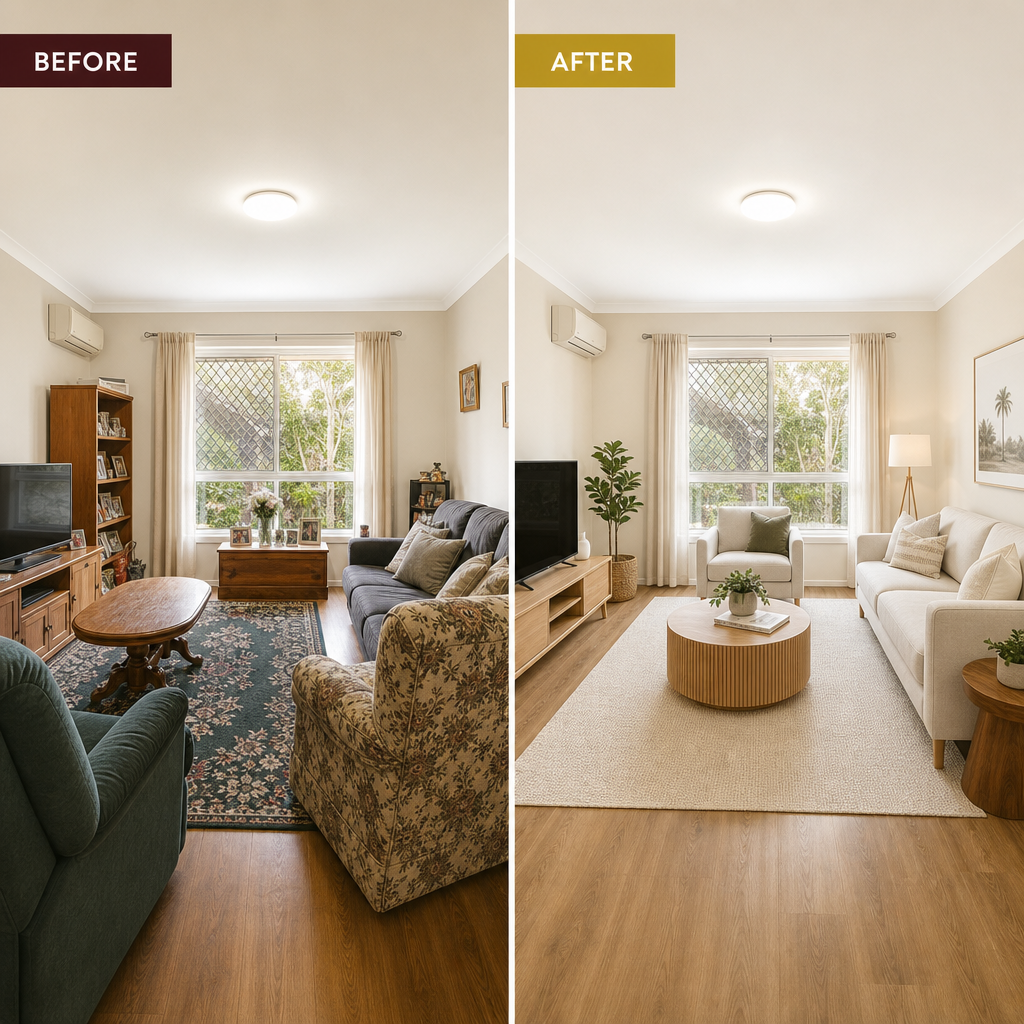
Property styling involves furnishing, decorating, and presenting your home to appeal to the broadest possible buyer audience. It is one of the most debated costs in real estate, but the data consistently supports it.
What Does Styling Cost?
- Partial styling (key rooms only, using a mix of existing and hired furniture): $2,000 to $4,000
- Full staging (vacant property, full furniture hire and styling): $4,000 to $10,000
- Styling consultation only (advice on de-cluttering, rearranging, colour): $200 to $600
The cost varies by property size, the number of rooms staged, and the hire period. Most campaigns run four to six weeks, so furniture hire costs are time-dependent.
Does Staging Add Value?
A well-styled property typically photographs better, presents better at inspections, and generates stronger emotional responses from buyers. The Real Estate Institute of Australia has noted that styled properties tend to sell faster and at stronger prices than comparable unstyled properties, though the premium varies by market and price point.
For a vacant investment property, staging is close to non-negotiable. Buyers struggle to contextualise empty rooms. For an owner-occupied home with existing furniture, a partial style or professional consultation often delivers the best return on investment.
Pre-Sale Repairs and Presentation
This is the cost category that catches most vendors off guard, and the range is the widest of all.
What Falls Under Pre-Sale Presentation?
- Cleaning: Professional pre-inspection clean costs $300 to $800 for a standard house.
- Garden and landscaping: Lawn mowing, mulching, hedge trimming, and basic garden refresh: $300 to $2,000.
- Interior painting: A full interior repaint of a four-bedroom home: $5,000 to $12,000. Spot touch-ups: $500 to $1,500.
- Carpet replacement or cleaning: Professional carpet cleaning: $200 to $600. Replacement: $3,000 to $8,000 depending on floor area.
- Minor repairs: Leaking taps, broken door handles, cracked tiles, worn grouting: $500 to $3,000.
- Cosmetic kitchen or bathroom updates: New tapware, handles, a coat of paint on cabinetry: $1,000 to $5,000. A full bathroom renovation is rarely justified purely for sale purposes.
How Do You Decide What to Fix?
This is where the right agent earns their fee. An experienced agent knows which improvements buyers in your suburb respond to and which ones you will not recover in the sale price. Over-capitalising on pre-sale renovations is a real risk. Under-presenting is an equally real risk.
My standard advice: fix anything that looks broken or neglected, because buyers use visible defects to justify lower offers. Do not renovate to your personal taste. Present clean, neutral, and well-maintained.
Building and Pest Inspection Reports
In most states, the buyer pays for building and pest inspections as part of their due diligence. However, some vendors commission a pre-sale building and pest report to get ahead of potential issues.
The argument for a vendor-commissioned report: you know what is there before buyers do, which means you can either address it, price it in, or disclose it confidently rather than have a buyer use it as negotiation leverage after a signed contract.
Building and pest inspections in 2026 typically cost between $400 and $1,000 depending on property size, location, and whether building and pest are combined or separate.
For older Queensland homes particularly, a pre-sale pest inspection is strongly worth considering. Termite activity is a known buyer concern in South East Queensland and a report showing a clean result, or documented treatment history, can meaningfully reduce buyer hesitation.
Mortgage Discharge Fees
If you have a mortgage on the property you are selling, your lender will charge a discharge fee to formally remove the mortgage from the title at settlement. This is a compulsory cost if your loan has not been fully repaid.
Mortgage discharge fees in Australia typically range from $150 to $1,500. The variation comes from:
- The lender (big four banks tend to charge more than smaller lenders)
- Whether you have a fixed-rate loan with break costs
- Whether there are multiple mortgages on the title
Break costs on fixed-rate loans deserve special attention. If you are selling before your fixed rate term ends and interest rates have moved significantly, break costs can be substantial, sometimes tens of thousands of dollars. Contact your lender before listing if you are on a fixed rate, and get the break cost in writing.
For a clear walkthrough of how mortgage discharge fits into the settlement process, read our article on understanding the property settlement process in Australia.
Capital Gains Tax: The Cost That Can Dwarf Everything Else
Capital gains tax is not a selling cost in the same way commission or conveyancing is, but it is potentially the largest financial consequence of a sale, and it is one of the most misunderstood.
Who Pays CGT When Selling Property in Australia?
CGT applies to the sale of assets that are not your principal place of residence. If you are selling the home you have lived in continuously, you are generally eligible for the main residence exemption and pay no CGT. If you are selling an investment property, a holiday home, or a property that was once your home but has been rented, CGT applies.
The ATO calculates your capital gain as the difference between your cost base (what you paid, plus eligible costs) and your sale proceeds. If you have owned the property for more than 12 months, you are entitled to a 50% CGT discount as an individual. The net gain is then added to your taxable income for that financial year.
A Worked CGT Example
An investor purchased a Brisbane unit in 2018 for $420,000. They sell in 2026 for $720,000. The capital gain before discount is $300,000. After the 50% discount for individuals, the taxable gain is $150,000. If that investor is in the 37% tax bracket, the CGT liability is approximately $55,500.
That is a cost that no commission or staging budget comes close to. Planning the timing of a sale, the ownership structure, and the use of legitimate deductions in the cost base can make a material difference to this outcome.
For a full breakdown of how CGT applies to property sales in Australia, including the main residence exemption and the 50% discount rules, see our detailed guide on capital gains tax when selling property in Australia.
A Worked Example: Selling a $900,000 Melbourne Home
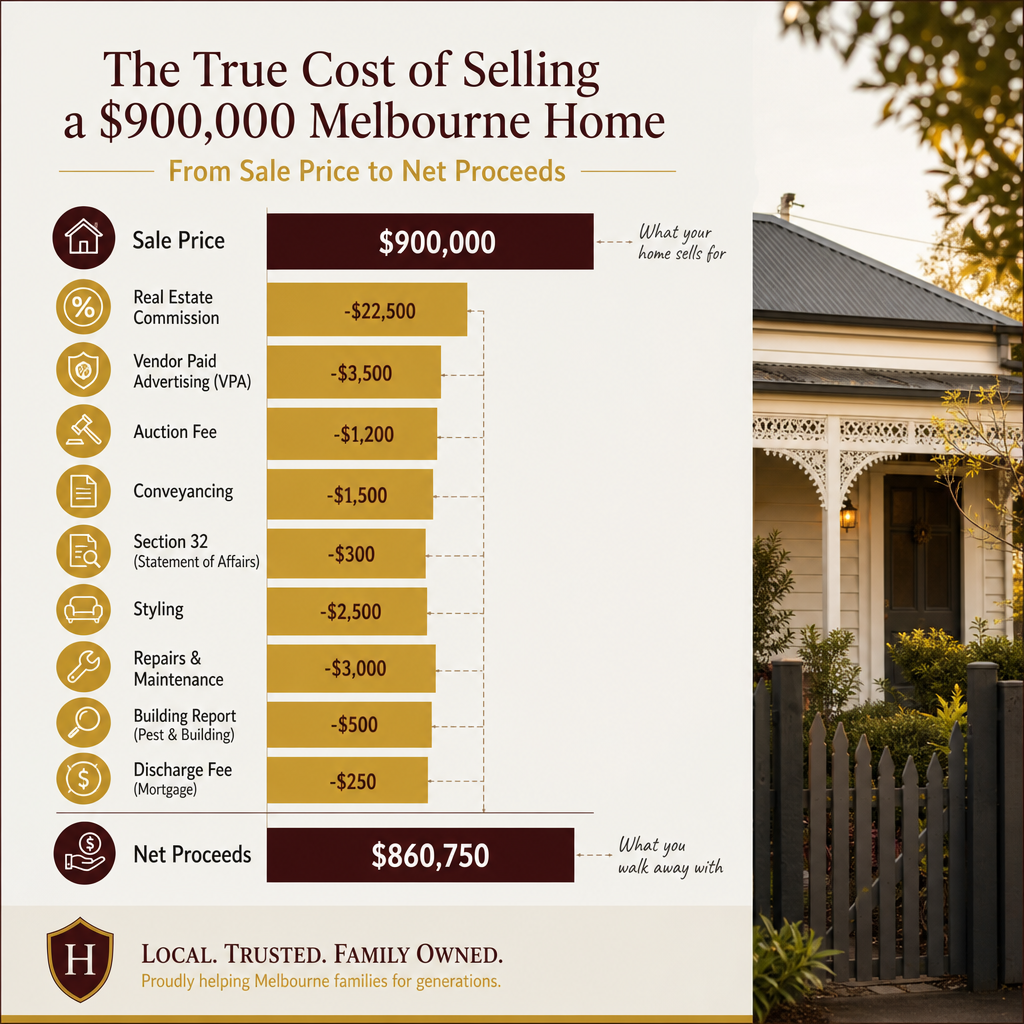
Let us make this concrete. Here is a realistic cost breakdown for a vendor selling a four-bedroom house in Melbourne's middle ring for $900,000 in 2026, selling by auction, owner-occupied (no CGT).
| Cost Item | Estimated Amount |
|---|---|
| Agent Commission (2.2%) | $19,800 |
| VPA / Marketing Campaign | $7,500 |
| Auctioneer Fee | $800 |
| Conveyancing and Legal | $1,800 |
| Section 32 Preparation | $500 |
| Professional Styling (partial) | $3,500 |
| Pre-Sale Repairs and Presentation | $4,200 |
| Building and Pest Report | $650 |
| Mortgage Discharge Fee | $500 |
| Total Selling Costs | $39,250 |
| Net Proceeds (before CGT) | $860,750 |
Total selling costs as a percentage of sale price: approximately 4.4%.
This is not a worst-case scenario. It is a realistic, well-run campaign. The vendor in this example gets professional presentation, strong marketing reach, and competent legal handling. They know their net number before they accept an offer.
State-by-State Selling Cost Variations
Selling costs are not uniform across Australia. Here are the key state-specific variables:
Queensland
QLD uses a contract-based system rather than a vendor statement, and conveyancing fees are competitive at $900 to $2,000 for a standard residential sale. Commission rates tend to be higher than the southern states, reflecting the market structure and the fact that agents are typically more involved in the negotiation process. There is no stamp duty payable by the vendor. First home buyer concessions on the buyer side do not affect vendor costs.
Victoria
VIC is the Section 32 state. Vendors must prepare and provide this disclosure document before contracts are signed, adding $300 to $800 to legal costs. Auction is the dominant method in Melbourne metro, making auctioneer fees a near-certain cost. Commission rates are among the lower end nationally, but VPA expectations are high in competitive suburbs.
New South Wales
NSW vendors pay for a Contract of Sale preparation, typically $1,500 to $3,000 through a solicitor, which includes the required title searches and planning certificates. Commission rates in Sydney metro tend to cluster around 1.8% to 2.5%. Marketing costs in competitive inner-Sydney suburbs can push well above $10,000 for a premium campaign.
Western Australia
WA has legislated commission scale guidelines, though negotiated rates are common below these caps. Conveyancing is often handled by licensed settlement agents rather than solicitors, with fees typically $1,200 to $2,000. VPA is often more modest than east coast markets.
South Australia
SA uses a Form 1 (Vendor's Statement) disclosure requirement, similar to Victoria's Section 32. Preparation costs are comparable. Commission rates are mid-range nationally. Auction is less common outside Adelaide's inner suburbs.
Two Real Case Studies from the Field
Case Study 1: The Beenleigh Apartment Complex
I was referred in to appraise an apartment complex in Beenleigh in early 2021. The developer owner was direct about his scepticism. He had dealt with plenty of agents and was not convinced a smaller agency could move his stock. His opening comment was essentially: "Give it a go, but I am not sure you can really do anything."
What he did not expect was the approach. I spent time learning the complex inside out: the body corporate structure, the strata levies, the building's specifications, and exactly what made each apartment different. When buyers came through, I was not presenting a property. I was presenting a complete picture that addressed concerns before they were raised.
We sold the first apartment. Then the second. Then the third. As of 2026, the agency has sold 12 apartments in that complex across five years, and the relationship with that developer is now genuinely one of the better ones I have in the business. He went from sceptical to one of our strongest referral sources.
The cost lesson from this case study: for new apartments, presentation costs were minimal because the product was fresh and well-built. The real investment was in marketing reach and buyer education. VPA and commission were the two meaningful costs, and both were recovered in full through competitive pricing achieved by informed, confident buyers.
Metrics: 12 apartments sold over 5 years. Average time on market per apartment: under 28 days. Vendor net proceeds consistently at or above initial appraisal.
Case Study 2: The Over-Capitalised Renovation Vendor
A vendor in outer South East Queensland came to us after spending $38,000 on a full kitchen and bathroom renovation before listing. The property was a solid three-bedroom house in a suburb where comparable sales were sitting between $520,000 and $560,000. The renovation had genuinely lifted the presentation, but the ceiling on the suburb meant buyers were not going to pay $600,000 regardless of how good the kitchen looked.
The property sold for $565,000. The vendor had hoped for $590,000 to justify the spend. The actual cost of selling including commission, marketing, and legal came to approximately $22,000. Total costs including the renovation: $60,000. Net proceeds were $505,000 on a property purchased four years earlier for $390,000. Not a bad outcome overall, but the renovation returned less than 30 cents in the dollar on its cost.
The lesson: pre-sale spending needs to be guided by what buyers in your specific suburb are paying for. A good agent will tell you honestly what to spend and what to skip.
Metrics: Sale price $565,000. Pre-sale renovation spend $38,000. Return on renovation cost: approximately 27%. Conventional pre-sale costs (commission, VPA, legal): $22,000.
What Vendors Often Miss: The Hidden Costs
Beyond the obvious line items, there are costs that regularly surprise vendors:
Holding costs during the campaign. If you have moved out before settlement, you are still paying mortgage repayments, council rates, body corporate fees, and insurance on a property generating no income. For a campaign running six to ten weeks plus a 30 to 90 day settlement period, this can add $3,000 to $12,000 in holding costs depending on the loan balance.
Strata records and certificates. For apartment or townhouse sales, obtaining current body corporate records, certificates of title, and strata history documents adds $200 to $600 and is often a prerequisite for the legal preparation.
GST on selling costs. All of the selling costs above attract GST. Commission, VPA, styling fees, conveyancing, and building reports all include GST at 10%. If you are selling as a private individual, you cannot claim this back. If you are selling as a GST-registered business entity, the rules are different and you should seek specific advice.
Removalist and relocation costs. Not strictly a selling cost, but the timing of your move ties directly to settlement. Removalist costs for a typical family home move within South East Queensland: $1,500 to $4,500.
How to Reduce Your Selling Costs Without Reducing Your Outcome
The goal is not the lowest possible selling cost. The goal is the best possible net proceeds. Those are different things.
Here is where smart vendors focus:
-
Choose your agent on value, not rate. A 0.5% commission saving on a $900,000 sale is $4,500. An agent who achieves $30,000 more through skilled negotiation has delivered $25,500 more to your pocket after the commission difference.
-
Be strategic about VPA. Ask your agent for evidence of how their past campaigns have performed relative to spend. A $4,000 campaign that generates 40 genuine inspections beats a $10,000 campaign that generates 20.
-
Spend on presentation, not renovation. Clean, repaired, and styled will almost always outperform freshly renovated in terms of return on spend.
-
Get your conveyancer involved early. Issues that surface late in the legal process cause delays that cost money and sometimes buyers.
-
Understand your CGT position before you list. If you are selling an investment property, the timing of settlement relative to the financial year end can affect your total tax liability.
A Note on Vendor Testimonial
"George & Sons were honest with us from day one about what it would cost to sell and what we would net. There were no surprises at settlement. We knew the number, we planned around it, and the whole process was clear and professional. We would not hesitate to recommend them." Vendor, South East Queensland, 2025
What to Do Next
If you are planning to sell in 2026, start with a clear-eyed cost estimate before you do anything else. Know your commission structure, your marketing budget, your legal costs, and your likely net proceeds before you accept a single offer.
The team at George & Sons provides obligation-free appraisals that include a plain-language cost breakdown, not just a price estimate. You will leave the conversation knowing what your property is worth and what it will cost to sell it.
Contact us for a no-obligation appraisal and cost estimate.
References
-
CoreLogic Australia, Property Market Reports 2026 - CoreLogic publishes ongoing median price, days on market, and vendor discount data for Australian residential property markets. Used for market context and typical cost benchmarking across states.
-
Australian Taxation Office (ATO), Capital Gains Tax Guide for Individuals - The ATO's official guidance on CGT calculations, the main residence exemption, the 50% individual discount, and cost base inclusions. The authoritative source for all CGT content in this article.
-
Real Estate Institute of Australia (REIA), Real Estate Market Facts - REIA compiles state-by-state commission rate data, median sale prices, and auction clearance rates. Referenced for commission rate ranges and auction market context.
-
Consumer Affairs Victoria, Section 32 Vendor Statement Requirements - Official Victorian government guidance on what must be included in a Section 32 Vendor Statement and the legal obligations of vendors prior to contract execution.
-
Real Estate and Business Agents Act 1978 (WA), Schedule of Commission Rates - Western Australian state legislation establishing the guideline commission rates applicable to residential property sales in WA.
-
Australian Bureau of Statistics (ABS), Housing Finance and Property Price Statistics 2026 - ABS data on residential property values, transaction volumes, and financing trends across Australian states and territories.
Get tailored guidance
Send us your question and we will reply within one business day.
Send us the article topic, suburb, or property goal you want help with and we will reply within one business day.
Send my questionFAQ
What is the typical total cost of selling a house in Australia?
For most vendors, the total cost of selling a house in Australia falls between 2.5% and 5.5% of the sale price. On a $900,000 property, that is approximately $22,500 to $49,500. The main cost drivers are agent commission, marketing (VPA), conveyancing, and pre-sale presentation. Capital gains tax, if applicable, can add significantly more for investment property owners.
Who pays what when selling a house in Australia?
The vendor (seller) pays agent commission, vendor paid advertising, their own conveyancing fees, pre-sale presentation costs, and any mortgage discharge fees. The buyer pays their own conveyancing fees, stamp duty, and building or pest inspection costs. In some negotiated scenarios, vendors may contribute to buyer incentives, but this is not standard practice in most Australian markets.
Can selling costs be negotiated?
Commission is negotiable in most Australian states, though the degree of movement varies by agent and market. VPA packages can sometimes be adjusted in scope. Conveyancing fees have less room for negotiation but can vary between providers. Auction fees are sometimes waived or included in the overall campaign package. The most important thing to negotiate is the full value of what you are getting, not just the headline cost.
Do I pay stamp duty when I sell my house?
No. Stamp duty (transfer duty) in Australia is paid by the buyer, not the seller. As a vendor, you do not have a stamp duty liability when you sell. However, if you are buying another property with the proceeds, you will pay stamp duty in your buyer role unless you qualify for a concession or exemption.
How does capital gains tax affect the cost of selling a house?
CGT applies to investment properties and properties that are not your principal place of residence. The gain is calculated as sale proceeds minus your cost base (purchase price plus eligible costs). Individuals who have owned the property for more than 12 months receive a 50% discount on the capital gain. The remaining gain is added to your taxable income. For long-held investment properties with substantial growth, CGT can be the largest single financial impact of the sale.
What is vendor paid advertising and is it worth paying for?
Vendor paid advertising (VPA) is the cost of promoting your property to buyers through online portals, social media, photography, signboards, and other channels. It is separate from agent commission. A well-structured VPA campaign increases buyer awareness, drives more inspections, and creates the competitive dynamic that supports a stronger sale price. For most properties, the return on a good marketing spend is positive, though the right budget depends on your market, price point, and property type.
How much does conveyancing cost when selling a house?
Vendor-side conveyancing fees in Australia typically range from $800 to $2,500 for a standard residential sale. In Victoria, Section 32 preparation is usually included in or added to this fee. The cost depends on the complexity of the transaction, your state, and whether you use a solicitor or licensed conveyancer.
Does it cost more to sell at auction versus private treaty?
Selling by auction adds an auctioneer fee of approximately $400 to $1,500, and often requires a more intensive marketing campaign ahead of the auction date, which increases VPA costs. However, a successful auction creates transparent, competitive bidding that can produce a higher sale price than private treaty. Whether auction is appropriate depends on your market, the level of buyer demand, and your agent's recommendation for your specific property.
Margy George
Property and finance guidance from the George & Sons team.
Keep reading
how to get your property ready to sell
How to Get Your Property Ready to Sell: A Practical Guide
24 min read
property management fees Australia
Property Management Fees in Australia: A Comprehensive Guide for Landlords
19 min read
real estate market trends Australia
35 Australian Real Estate Market Statistics for 2026
20 min read
Ready for clarity?
Get a calm, practical plan for your next property move.
Buying, selling, finance, or renting - tell us what you are working on and we will come back with the most useful next step.
Tell us what you need help with.
Send a quick enquiry and the team will come back with a clear next step.
Request a callback